Viking history for sleep: a calm night in the Viking Age, from longships and the Lindisfarne raid to Dublin, Iceland and Vinland. This sleep story walks slowly through the Viking Age, from about the late eighth century to the middle of the eleventh. It starts on the farms beside the fjords and follows the ships to Britain and Ireland, down the rivers of the east, and out across the North Atlantic to Iceland, Greenland and a brief shore in North America. It is narrated softly, with no loud sounds, no graphic violence and no ad breaks.
Who were the Vikings?
The people we now call Vikings spoke related North Germanic languages, in the lands we know today as Norway, Sweden and Denmark. In Old Norse, a viking could mean a voyage, or a person who went on one, often with raiding in mind. Yet most people in these lands spent their lives farming, trading and looking after their families. Historians still debate how tightly the word should be tied to a few centuries of overseas raiding, and how much ordinary Scandinavian life it should cover. The episode uses it gently, as a doorway into a longer story of northern peoples on the move.
What did Vikings eat?
Most days in the Viking Age turned on farms. People grew barley and rye, cabbage and onions, and kept cattle, sheep, goats, pigs and horses. Food was seasonal and inventive: dried fish, smoked meat, skyr-like dairy, flatbreads, porridge and buttered roots filled the bowls, while ale and mead appeared at feasts. Autumn was the time for slaughter and storage, and in the lean months the stores from that slaughter had to stretch. In winter, people lived close to the smell of wool, smoke and stored fish. Further west, Icelandic woollens and dried fish became goods in North Atlantic trade.
The episode doesn't follow a crew's rations at sea, so we won't guess at them here. What it describes is the larder those crews sailed from, and the duty of hospitality: refusing a traveller without good reason could stain a family's reputation.
How were Viking ships built?
Ships were what made the distances possible. The classic longship was long, narrow and clinker-built: overlapping planks clenched with iron rivets, so the hull flexed with the sea. Shipwrights chose oak when they could and pine when they had to, and caulked the seams with tar and animal hair. A square sail caught the wind, and oars took over when the wind dropped. Broader ships called knarrs carried cargo and settlers. Many voyages were about timber, furs, walrus ivory, silver and trade, not only raiding.
Where did Vikings sleep?
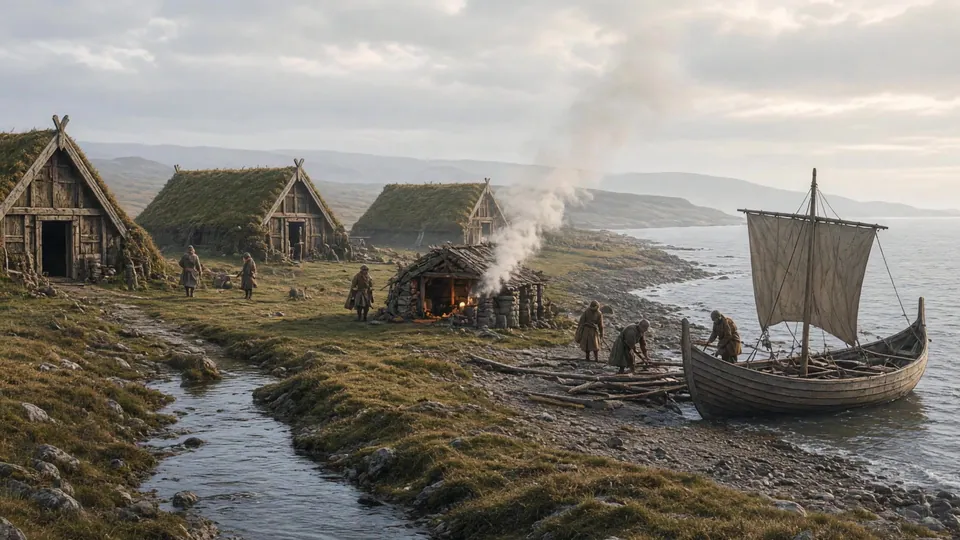
Most nights were spent at home, in a longhouse: a long building of timber and turf, where smoke found its way out through a smoke-hole in the roof. Benches lined the long walls, and they held both sleeping places and stored goods. A central hearth in the aisle gave light and heat, and the rafters above held hanging stores. In some layouts people and animals shared the same roof, and in winter the animals in byres attached to the dwelling added their warmth. Evenings ended with stories and gossip in the dim orange light while the hearth settled into coals. Away from home, crews tried to return before the worst winter storms, or wintered abroad, and over time their temporary camps became permanent bases. The episode doesn't describe how crews slept on board, so we won't guess at it here.
Where did the Vikings go?
The raid later ages treat as a landmark struck the monastery on Lindisfarne, off the Northumbrian coast, in 793. Historians are careful to say it may not have been the very first. In Ireland, Scandinavian ship camps grew into towns, Dublin among them. In England, a force the Anglo-Saxon Chronicle calls the Great Army campaigned from about 865; its size is still debated. Alfred of Wessex defeated a Danish army at Edington in 878, and the Danish leader Guthrum accepted baptism. Place-names ending in -by and -thorpe still mark the old Danelaw, and by 1016 Cnut ruled a North Sea empire linking England and Denmark.
In Francia, a leader named Rollo received lands around the lower Seine that became Normandy. To the east, travellers followed rivers toward Kyiv and Constantinople, which the Norse called Miklagard, and silver coins from the Islamic world flowed north in great quantities. In the Atlantic, settlement of Iceland sped up around 870, and the Althing assembly is traditionally dated to 930. Erik the Red promoted settlement in Greenland around 985 or 986. At L'Anse aux Meadows in Newfoundland, excavations since the 1960s have revealed a Norse site from around the year 1000: firm proof that Scandinavians reached North America.
What was daily life like on a Viking farm?
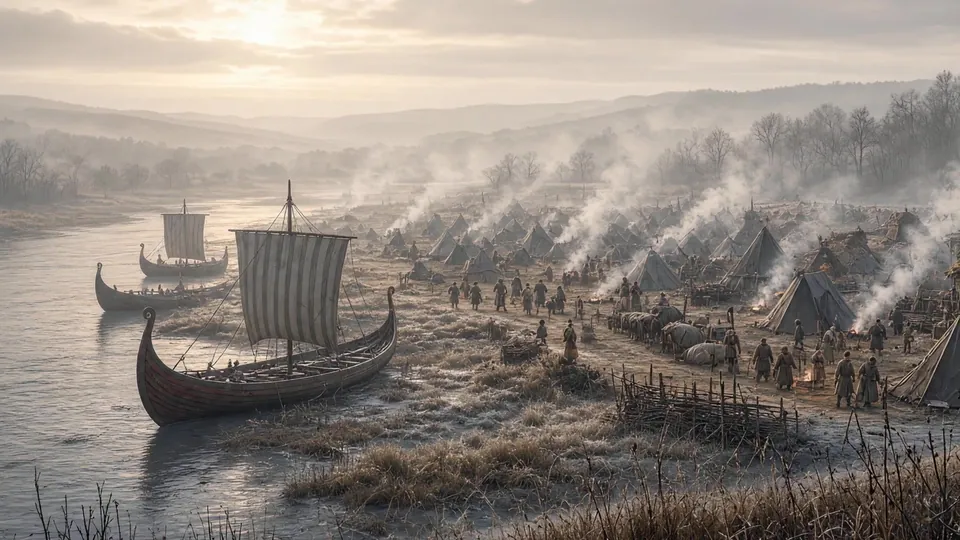
Most days turned on the farm, not the ship. Haymaking in the short summer was a race against rain, and a family's wealth might be counted in cows as readily as in silver rings. Women spun wool and linen and wove cloth on upright looms; that textile work underpinned household wealth and, in places, the sails of the ships. Men and women both worked leather, wood and bone, while specialists forged iron and raised the planks of boats. Children learned by watching: boys might practise with small tools and boats, girls with the spindle and dairy. Free men met at local assemblies, called things, to hear disputes and declare custom, and thralls did much of the cooking, herding and weaving. Winter evenings brought board games such as hnefatafl, poetry and long conversations.
How did the Viking Age end?
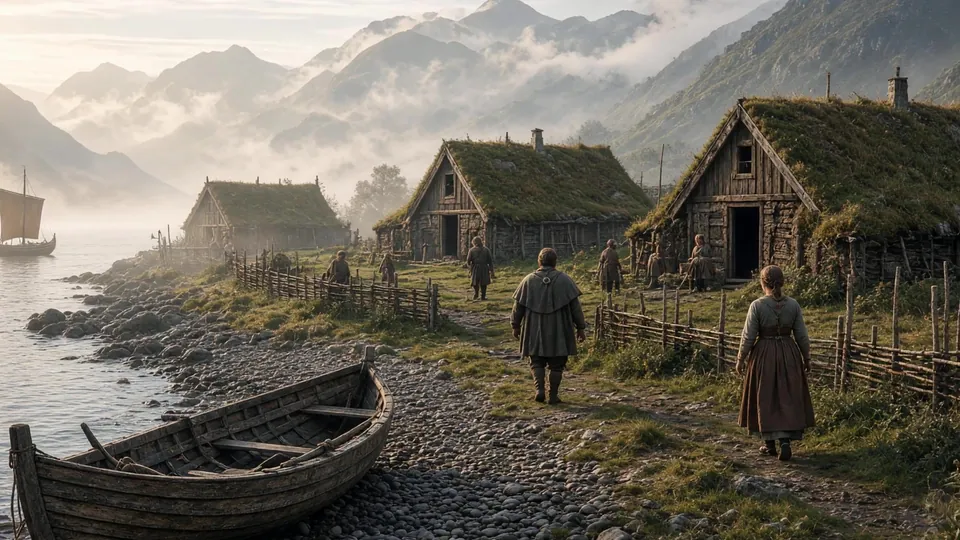
Slowly, and as a tide rather than a single event. Kings in Denmark, Norway and Sweden gathered wider power and took up Christianity. The rune stones at Jelling proclaim Harald Bluetooth's claim to have made the Danes Christian, and Olaf Haraldsson became Saint Olaf after his death at Stiklestad in 1030. Historians often use the death of Harald Hardrada at Stamford Bridge in 1066, less than three weeks before the Battle of Hastings, as a symbolic bookend. As the episode puts it, the age ended partly because the raiders' grandchildren became the kings and dukes of a Christian map.
About this sleep story
About 1 hour 6 min. Slow narration, soft music, no loud sounds, no graphic violence, no ad breaks. Made as history to fall asleep to: it's fine to drift off partway, and the chapters below let you find your place again.
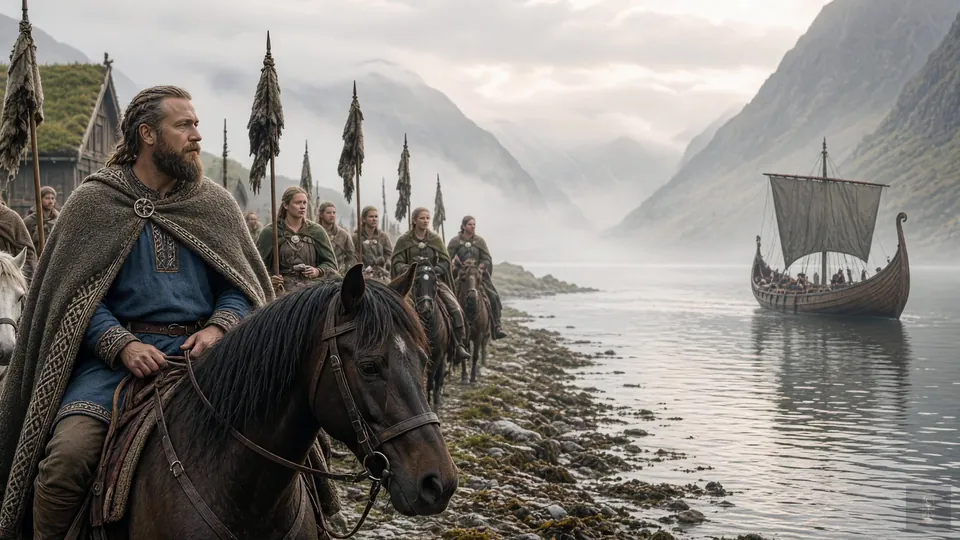
The narration voice is AI text-to-speech, from a script we research, write and fact-check, and the images are AI-generated artistic impressions, not historical records.
Chapters
- 00:00Intro
The plan for the hour: fjord farms, the first raids, new lands, law and craft, and the Christian kings who closed the age, with one picture to return to, a single square sail on grey water.
- 01:52Viking Homelands: Scandinavia, Longships, and the Lindisfarne Raid
Fjord farms and longhouses, clinker-built longships and broad knarrs, and the raid on Lindisfarne in 793 that later ages treat as a landmark. Why raiding grew is still debated.
- 12:48Vikings in the British Isles: Ireland, Dublin, and the Danelaw
Ship camps in Ireland that grew into towns such as Dublin, the Great Army from about 865, Alfred's victory at Edington in 878 and the Danelaw, through to Cnut's North Sea empire.
- 23:07Vikings in Francia and the Rus: The Long Roads East and South
Raids up the Seine and the Loire, the siege of Paris in 885 to 886 and Rollo's lands that became Normandy, then the river roads east toward Kyiv and Miklagard, and the silver that flowed north.
- 33:08Iceland, Greenland, and Vinland: The Vikings in the North Atlantic
Iceland's rapid settlement and its Althing, traditionally dated to 930, Erik the Red's Greenland around 985 or 986, and the Norse site at L'Anse aux Meadows in Newfoundland from around the year 1000.
- 43:34Viking Daily Life: Farms, Laws, Gods, and the Quiet Arts of the North
The quieter life behind the voyages: farms and longhouses, textiles and crafts, assemblies and law, the old gods, runes and skaldic poetry.
- 54:36Kings, Conversion, and the End of the Viking Age
Kings in Denmark, Norway and Sweden take up Christianity, from the Jelling stones to Saint Olaf at Stiklestad in 1030. Harald Hardrada's death at Stamford Bridge in 1066 makes a symbolic bookend.
Read the narration
The narration as it's spoken in the video, chapter by chapter, with the spoken channel notes (subscribe, comments) left out.
00:00Intro · 250 words
Hello, and welcome to Dreaming Ages History. Tonight we travel north, to fjords and islands, and to long timber ships. Those ships once slipped along coasts from Scandinavia to the British Isles, to Francia, and to the rivers of the east. For a short season of memory, they even reached toward a wooded shore across the western ocean. Over the next hour, we'll walk gently through the story often called the Viking Age. We'll begin in homelands of farm and forest, and pass through the first raids and the settling of new lands. We'll linger with trade and law and quiet craft, and at last reach the rise of Christian kings and the soft closing of an age.
As we go, keep one small picture in mind: not a battlefield, but a sail on grey water. A single square of cloth on the northern sea, or a sail lowered in a calm inlet while the fjord holds its quiet—voyage, farm-and-sea rhythm, and return. Ordinary lives, lived between mountain and sea. Tonight we will keep returning to that sail, the way a sleeper returns to the sound of waves against a wooden hull.
Now settle in, let your shoulders soften, and let your breathing slow. Let the room grow quiet around you. There will be no sudden noises in this hour, only a soft voice and a very old northern sea.
Our story opens where pine forests meet salt water, long before the word Viking became a name for an age.
01:52Viking Homelands: Scandinavia, Longships, and the Lindisfarne Raid · 1,269 words
Long before chroniclers in distant monasteries wrote of sudden ships on the horizon, there were farms beside the fjords. Scandinavia in the early medieval centuries was not an empty wilderness waiting for history to begin. It was a mosaic of valleys, islands, and coastal strips. People raised barley and rye, kept cattle and sheep, fished cold waters, and cut timber that smelled of resin when fresh. Winters were long. Summers were bright and brief. Communities measured wealth in cattle, silver, ships, and reputation.
The people we later call Vikings spoke related North Germanic languages. Their world stretched across what we now know as Norway, Sweden, and Denmark, with close ties to the islands and coasts beyond. The label Viking itself is slippery. In Old Norse, a viking could mean a voyage, or a person who went on such a voyage, often with raiding in mind. Yet most people in these lands spent their years farming, trading, and tending kin. Historians still debate how tightly we should bind the word to a few centuries of overseas activity, and how much ordinary Scandinavian life it should cover. For tonight, we will use it gently, as a doorway into a longer story of northern peoples in motion.
Picture a longhouse in late autumn. The roof is turf and timber. Smoke finds its way toward a smoke-hole. Along the walls, benches hold sleeping places and stored goods. In the central aisle, a hearth glows. Someone mends a fishing net. Someone else sharpens a tool with slow, even strokes. Outside, the fjord lies dark and still under a sky already thick with stars. This is the everyday stage on which the more famous voyages would later rest.
Ships were the keys that unlocked distance. Scandinavian builders developed vessels that could sail open water and also nose into shallow rivers and beaches. The classic longship was long, narrow, and clinker-built—overlapping planks fastened so the hull flexed with the sea. A square sail caught the wind. Oars answered when the wind failed or when stealth mattered. Broader knarrs carried trade goods and settlers with more cargo space and a sturdier belly for ocean swells. We need not imagine every voyage as a charge of warriors. Many journeys were about timber, furs, walrus ivory, slaves, silver, and the quiet arithmetic of exchange.
Archaeology shows that Scandinavia was already linked to wider European networks before the famous raids. Beads from distant workshops, Frankish swords, Arabic silver coins, and Insular metalwork appear in graves and hoards. Trade routes ran south through Denmark toward the Frankish world, and east from Swedish coasts toward the Baltic and the river systems of eastern Europe. When we speak of a Viking Age beginning around the late eighth century, we are marking a shift in intensity and visibility. The shock of raids on Christian coasts was new, more than any sudden invention of seafaring.
The raid that later ages treat as a landmark came in the year 793. The monastery on Lindisfarne, a tidal island off the Northumbrian coast of England, was attacked. The Anglo-Saxon Chronicle and letters of alarm from churchmen describe shock, plunder, and sacred spaces violated. Whether this was truly the first such strike, or simply the one that entered Latin writing with the loudest cry, historians are careful to note. What is clear is that coastal monasteries were often wealthy and lightly defended. They offered tempting targets for crews who could arrive with the tide, and leave before a kingdom's levy gathered.
Why did raiding intensify in these decades? Scholars offer braided answers rather than a single key. Population and inheritance pressures may have pushed younger men overseas. Political competition among chieftains rewarded displays of wealth and followers. Improvements in ships made longer hops safer. Demand for silver and slaves in northern and eastern markets pulled crews outward. Climate and harvest luck played their parts in a world where a bad year could empty a barn. We will not pretend the debate is settled. For a sleep journey, it is enough to feel the pull of grey water under an outward sail.
Imagine a departure at dawn. The ship is launched from a gravel beach. Men push until the keel lifts. Oars find their rhythm. The sail rises, damp and heavy at first, then taut with wind. Behind them, a farm shrinks to a dark line of trees. Ahead, the North Sea opens like a grey sheet. Some will return with silver rings and stories. Some will settle on foreign shores. Some will not return at all. The sea keeps its own accounts.
Early targets included other monastic houses and coastal settlements around the British Isles and Francia. The pattern was seasonal for many crews. They farmed in summer's heart, raided or traded when conditions favoured, and returned before the worst winter storms. Or they wintered abroad, when opportunity and politics allowed. Over time, temporary camps became permanent bases. The raider's summer could harden into a settler's year.
Scandinavian society at home was not a single kingdom marching in step. Power rested with local chieftains, assemblies, and, gradually, with ambitious rulers who sought wider lordship. Free farmers mattered. So did thralls—unfree labourers whose lives are harder to hear in the sources, yet whose work underpinned halls and harvests. Women of free families managed farms, wove cloth that was wealth itself, and sometimes held property and influence that later law codes would try to describe. Honour was a public currency. Feuds could smoulder for years. Poetry and reputation travelled farther than any single sword stroke.
Religion in this early period was not yet the Christianity of later northern kings. People honoured gods whose names still echo, Odin, Thor, Freyja, and others, through sacrifice, feast, and story. Sacred groves, halls, and high seats mattered more than stone cathedrals. Burial customs varied. There was cremation or inhumation, mounds and ship settings, and grave goods that speak of status and belief. We should be careful not to turn every find into a tidy mythological chart. Lived religion was local, practical, and woven through seasons of farming and sailing.
By the early ninth century, the pattern was set. Scandinavian ships appeared with unsettling regularity on the coasts of Christian Europe. Sometimes they came as traders welcomed at markets, sometimes as raiders feared at dawn. The same farmer who milked goats in a Norwegian valley might, in another season, unload silver at a Frisian port or stand on a Northumbrian beach. The Viking Age, as later historians named it, had begun its long weather front across the northern world.
Shipwrights chose oak when they could, and pine or other woods when they must. A keel was laid like a spine. Ribs rose. Planks overlapped and were clenched with iron rivets. Tar and animal hair caulked the seams. When a new ship first took water, the whole farm might gather to watch—because a vessel was wealth, risk, and pride made visible.
Seasonal rhythms bound the coasts. Spring meant repairing gear and watching ice leave the inner fjords. Midsummer brought long light for travel. Autumn demanded slaughter and storage. Midwinter feasts held communities together when the sun barely cleared the hills. Raiding chronicles rarely mention these clocks, yet every crew lived by them.
So the homelands settle into memory. There is longhouse smoke and fjord light, and clinker planks and square sails. There is Lindisfarne's alarm in 793, and a people whose ordinary farms fed extraordinary voyages. Now the ships turn more steadily toward the British Isles and Ireland. There, raiding will deepen into settlement, and a region later called the Danelaw will reshape the map of England.
12:48Vikings in the British Isles: Ireland, Dublin, and the Danelaw · 1,177 words
After Lindisfarne, the coasts of Britain and Ireland learned the sound of unfamiliar keels. Through the early ninth century, raids struck monasteries and settlements from Iona to the Thames. Irish annals record attacks on island houses of prayer. English chronicles note ships in rivers that once felt safe. The shock was real for communities whose wealth was stored in churches and whose kings could not always answer quickly enough. Yet even in these decades, exchange continued. Silver, captives, and goods moved in both directions, and the line between raid and trade was not always a bright wall.
Ireland felt the northern presence deeply. Scandinavian groups established longphuirt, ship camps and fortified bases, along rivers and coasts. Dublin grew from such a foothold into a major town of the Irish Sea world, a place of markets, craft, and power struggles with Irish kings. Other centres rose at places like Waterford, Wexford, Limerick, and Cork. These were not simply foreign garrisons perched on alien soil forever. Intermarriage, alliance, and rivalry braided Norse and Gaelic elites. Historians speak of a Norse-Gaelic world in which identities could be layered rather than pure.
Imagine Dublin's harbour on a misty morning. Timber warehouses hold hides and walrus ivory. A smith's hammer rings. Someone counts silver by weight. Gaelic and Norse speech mingle in the lanes. A king rides out to meet another king, gifts and threats riding in the same saddlebag. The Irish Sea has become a busy lake of ambition.
In England, the stakes grew larger in the mid-ninth century. From about 865, a force often called the Great Army campaigned year after year across the English kingdoms. The Anglo-Saxon Chronicle calls it the Great Heathen Army. Its size is debated. Chroniclers' numbers are hard to trust, and modern estimates vary widely. What is clearer is its persistence. Unlike summer raiders who vanished with the autumn, this army wintered, moved, negotiated, and fought through seasons. Northumbria fractured. East Anglia fell. Mercia was pressed hard. Wessex under kings like Aethelred and then Alfred struggled to survive.
Alfred of Wessex, later remembered as Alfred the Great, reorganised defences, built fortified burhs, and negotiated as well as fought. In 878, after a winter surprise at Chippenham, Alfred took refuge for a time in the marshes of Athelney. Then his forces defeated a Danish army at Edington. A treaty followed. The Danish leader Guthrum accepted baptism, and boundaries were drawn that left much of eastern and northern England under Scandinavian-influenced rule—a region later historians call the Danelaw. The exact legal meaning of that term evolved over time. It is better understood as a zone of custom, settlement, and political reality, than as a single neat statute.
Within the Danelaw, place-names still whisper of Norse speech. Endings like by and thorpe mark farms and villages across Yorkshire, Lincolnshire, and beyond. Farmers ploughed English soil with Scandinavian neighbours. Laws blended. Towns such as York, called Jorvik by its Norse speakers, became bustling centres of craft and trade. Archaeology there has revealed workshops, shoes, combs, and the ordinary clutter of urban life, far from the cartoon of endless battle.
Picture a street in Jorvik in soft rain. Wooden houses lean close. A child carries water. A trader unpacks amber and furs. Somewhere a woman weaves on a warp-weighted loom, the same patient craft known across the North Sea world. Kings and jarls may argue over tribute, but the street keeps its own rhythm of bread and repair.
Scotland and the northern isles took their own path. Orkney and Shetland came under strong Norse influence. The Hebrides and parts of the mainland saw settlement and lordship that lasted for centuries. The earldom of Orkney became a power in its own right, looking both to Norway and to the Scottish kingdoms. Sagas written much later in Iceland remember these northern lords with a mix of genealogy and drama. Historians read them with caution, weighing memory against archaeology and the scraps of chronicle written at the time.
Wales and the western coasts also knew raids and, at times, alliances. Scandinavian fleets used the Irish Sea as a highway. Sometimes Welsh rulers fought the newcomers. Sometimes they hired them, or married into their networks. The political map of Britain in the ninth and tenth centuries was a shifting weave, not a simple story of one island against invaders.
By the early tenth century, English kings of Wessex and then of a widening English realm pushed back into the Danelaw. Edward the Elder and his sister Aethelflaed, Lady of the Mercians, fortified towns and reclaimed ground. Athelstan, in the nine-twenties and nine-thirties, projected power farther still. Tradition remembers his victory at Brunanburh in 937. The battle's exact site remains debated, though its political weight in English memory is clear. Scandinavian settlement did not vanish when overlordship changed. People stayed. The names stayed. Law and custom left deep footprints.
The tenth and early eleventh centuries brought new waves. Swein Forkbeard of Denmark campaigned hard in England. In 1013 he seized the English throne briefly. After his death, his son Cnut, Canute in later English spelling, won the kingdom by the year 1016. He ruled a North Sea empire that linked England, Denmark, and, for a time, Norway. Cnut presented himself as a Christian king among Christian kings, issuing laws and patronising the church even as his power rested on Scandinavian military networks. The old raid-and-settle pattern had matured into dynastic politics on a European stage.
Ireland's Norse towns remained players into the eleventh century. The famous battle of Clontarf was fought in 1014. There Brian Boru of Munster fought a coalition that included Dublin's Norse, and the battle has been wrapped in later legend. Modern historians caution against reading it as a simple final defeat of all Vikings in Ireland. Norse-Gaelic towns continued afterward. What changed, slowly, was the balance of power and the deepening entanglement of identities.
Through all these campaigns, ordinary life continued in the gaps between famous dates. A thrall stacked firewood. A freewoman counted lambs. A merchant weighed silver dirhams that had travelled from the Islamic world through eastern routes to a northern purse. The British Isles had become one of the great theatres of the Viking Age. They were not only a place of fear, but a place of new towns, new names, and new kinds of belonging.
Language left its soft archaeology too. In areas of dense Norse settlement, English absorbed everyday words and place-name patterns that still colour speech. Law codes of later English kings struggled to manage mixed populations and older Danish customs. The Danelaw was not erased by reconquest so much as folded into a larger English story.
So the western islands settle into memory. Lindisfarne's shock gives way to Dublin's lanes, and to the Great Army's long winters. There is Alfred's hard-won peace, Danelaw place-names in the rain, and Cnut's North Sea crown. Now we turn toward Francia and the long rivers east. There Scandinavian travellers would bargain, raid, and settle along roads of water that led toward Byzantium and the silver of the south.
23:07Vikings in Francia and the Rus: The Long Roads East and South · 1,169 words
While English and Irish coasts learned the northern ships, the Frankish world felt them along its rivers and channel shores. That world was heir to Charlemagne's empire. From the early ninth century, Scandinavian fleets entered the Seine, the Loire, and other waterways. They struck towns and monasteries that had grown rich in an age of relative security. Paris itself was besieged more than once. The siege of 885 to 886 became famous in later telling. Count Odo defended the city, while the empire around it frayed.
The Frankish response mixed fighting, fortification, and payment. Silver given to buy peace, sometimes called tribute, could end one season's threat and invite the next. Over time, a different solution took shape in northern Francia. In the early tenth century, a Scandinavian leader named Rollo received lands around the lower Seine from the Frankish king Charles the Simple. Norse tradition knows him as Gǫngu-Hrólfr. The grant is traditionally dated to about 911, in the treaty associated with Saint-Clair-sur-Epte. Specialists argue over the details of the agreement, working from later sources. Yet the outcome is clear enough. A Norse polity took root that would become Normandy, the land of the Northmen.
Imagine the Seine mist at dawn. A longship rests against a muddy bank. In a hall nearby, a former raider listens to Frankish clerks explain land and loyalty. His grandchildren will speak a Romance tongue, pray in stone churches, and ride as heavy cavalry. The transformation from viking to Norman would take generations, but it began with settlement, baptism, and the slow work of becoming local.
Normandy's dukes grew powerful. By the eleventh century, Duke William would cross the Channel in 1066 and seize the English crown. It is an irony of history. Descendants of Scandinavian settlers conquered a kingdom that had itself been remade by earlier northern migrations. We need not retell Hastings in detail tonight. It is enough to notice how thoroughly the Viking Age's western currents could change the map of Europe.
Far to the east, another set of roads opened—roads of river rather than open ocean. From the Swedish coasts and Gotland, travellers entered the Baltic and followed river systems into the lands of the East Slavs and beyond. They used portages where water failed, dragging ships between watersheds. Along these routes rose trading posts and strongholds that Arabic and Byzantine writers associated with people they called Rus. The relationship between Scandinavians, Slavs, and the early Rus polity is one of scholarship's livelier debates. How much was Scandinavian leadership, how much Slavic continuity, and how quickly did identities fuse? Soft hedges belong here. What archaeology and texts together show is a world of exchange linking the Baltic to the Black Sea and the Caspian.
Goods moved in both directions. Furs, slaves, wax, and honey travelled south and east. Silver, especially Islamic dirhams, flowed north in astonishing quantities, buried in hoards across Scandinavia and the Baltic. Byzantine silk and glass found their way into northern graves. At Constantinople, the great city the Norse called Miklagard, some Scandinavians served as mercenaries in the emperor's Varangian Guard. Later sources made them famous for loyalty, and for formidable axes. Standing on the city's walls, a northerner might look out on a skyline of domes and remember a turf roof above a fjord.
Picture a river camp at dusk somewhere between Novgorod's sphere and the steppe's edge. Fires glow. Guards watch the dark. A trader checks the lashings on a cargo of furs. Tomorrow there may be negotiation with local princes, or a portage over muddy ground, or a bargain struck in a language half-learned. The eastern road was never only adventure. It was logistics, risk, and patience.
The Primary Chronicle, compiled later in Kyiv, tells origin stories of Rus princes invited to rule—stories modern historians treat as political myth mixed with memory. Names like Rurik, Oleg, and Igor appear in these traditions. By the tenth century, a Rus power centred on Kyiv dealt with Byzantium in war and treaty. The generations of Princess Olga and Prince Vladimir saw deepening Christian influence. It culminated in Vladimir's adoption of Byzantine Christianity around 988. That was a turning point for the region's religious history, even as northern pagan customs lingered in places far from cathedral doors.
South and west of Francia, Scandinavian activity reached the Iberian coasts and the Mediterranean in episodic raids and ventures during the ninth century. Fleets entered the Guadalquivir. Others probed Italy and beyond. These were not permanent empires, but they show how far ambition and rumour could carry a sail. In the Mediterranean, northern crews entered a crowded arena of Muslim, Christian, and older local powers, where a longship was only one kind of predator among many.
Trade towns in the north flourished as nodes in these networks. Hedeby, near the base of the Jutland peninsula, sat on a neck of land where goods could cross between Baltic and North Sea worlds. Birka, on an island in Lake Mälaren in Sweden, gathered merchants and crafts, and later so did sites like Sigtuna. Ribe in Denmark shows early urban stirrings. Excavations reveal workshops, weights for silver, and the mixed debris of many peoples. A sleep history can linger on a single amber bead on a market stall, catching afternoon light, and let that stand for a continent of exchange.
Raiding and trading were not always separate careers. The same crew might sell at a fair one month and threaten a poorly guarded estuary the next. Christian writers naturally emphasised the terror. Arabic geographers and travellers, encountering northerners on eastern routes, described them with a mixture of curiosity and distaste. Reading all these voices together, we hear a people who were farmers at home and opportunists abroad. They were neither demons nor romantic heroes, but participants in a hard medieval economy of silver and labour.
Slavery was part of that economy. Captives taken in raids or wars could be sold in Irish Sea markets, in Frankish entrepôts, or along the eastern rivers toward the Islamic world. A sleep journey does not dwell on cruelty for spectacle. But it also does not erase the fact. Many unnamed people crossed those waters unwillingly. Their lives, too, belong in the picture beside the free farmer's and the chieftain's.
By the tenth century, the long roads east and south had made Scandinavia less a remote peninsula and more a northern hinge of Eurasian exchange. Silver from far caliphates weighed in a Danish hand. A Swedish traveller might die in a Byzantine barracks. A Norman lord in Francia might still half-remember a grandfather's sea stories. The Viking Age was always bigger than one island's chronicles.
So Francia and the eastern rivers settle into memory. There is Paris under siege, and Rollo's Seine lands becoming Normandy. There are Rus routes toward Miklagard, dirham silver in northern soil, and markets where amber and fur met silk. Now we follow sails farther west still—to Iceland's open settlements, Greenland's fragile farms, and a brief landing in a place the sagas called Vinland.
33:08Iceland, Greenland, and Vinland: The Vikings in the North Atlantic · 1,187 words
West across the open North Atlantic lay islands that would draw settlers seeking land, status, and distance from overlords at home. The Faroes received Norse settlers in the early Viking Age. Archaeology and environmental evidence refine the exact timings, and scholars continue to discuss how early the farmsteads took hold. Beyond them lay Iceland, an island of volcanoes, glaciers, and grassy coastal strips. No native farming population awaited the newcomers there. Irish monastic visitors may have come before them in small numbers, if later traditions preserve a grain of truth.
According to Icelandic tradition, organised settlement accelerated around 870, often symbolised by the land-taking of Ingólfr Arnarson at the place that became Reykjavík. Modern historians treat saga dates as approximate frameworks rather than precise diaries. Yet archaeology supports a rapid landnám, a land-taking, in the late ninth and early tenth centuries. Settlers came mainly from Norway, and also from Norse communities in the British Isles, bringing Celtic names, thralls, and mixed heritage into the new society.
Imagine a new farm on an Icelandic headland. Turf walls rise. Driftwood is precious. A family watches the light last late into a summer night, then endure the long dark of winter. There are no towns like Dublin here at first—only farms, chieftains' halls, and the gathering places where law will be spoken aloud. The wind has a clean, endless voice.
Iceland developed a distinctive political experiment, a commonwealth without a king. It was organised through local chieftains called goðar, and through an annual national assembly, the Althing. The Althing was traditionally founded in 930, at Thingvellir. Free men recited and amended law. Disputes were settled by arbitration and compensation, and sometimes by feud when peace failed. It was not a modern democracy. Women, thralls, and the poor stood outside full power. Yet the idea of a society binding itself by spoken law under an open sky remains one of the Viking Age's most striking legacies.
From Iceland, further voyages pushed west. Erik the Red, exiled after killings, explored and promoted settlement in Greenland in the late tenth century—traditionally around 985 or 986. He gave the land a green name to attract settlers, a piece of early advertising the sagas themselves smile at. Two main Norse areas took shape, the Eastern Settlement and the Western Settlement. They were really southern and southwestern pockets of pasture along fjords, not the island's icy interior. Farms raised cattle and sheep. Hunters took seals and walrus. Life was possible, but always near the edge.
Greenland's Norse would endure for centuries, before fading in the late medieval period. Historians explain that disappearance with a cooling climate, failing contacts with Europe, and resource stress. They also point to competition and contact with the Inuit, and to social choices whose balance remains debated. For our night journey in the Viking Age proper, what matters is that these farms existed. There were church bells later, and turf walls always, and a horizon of ice that could look like the end of the world.
Beyond Greenland, explorers reached a land of timber and self-sown wheat, and wild grapes or berries. So say the Vinland Sagas, the Saga of the Greenlanders and the Saga of Erik the Red. There they met native peoples the Norse called Skraelings. Leif Erikson is credited in these traditions with naming Vinland. The sagas disagree on details and sequences. They were written down centuries after the events they describe. Historians and archaeologists therefore walk softly.
At L'Anse aux Meadows, on the northern tip of Newfoundland, excavations since the 1960s have revealed a Norse settlement. It has turf buildings, and evidence of ironworking and ship repair. It is firm proof that Scandinavians reached North America around the year 1000. Whether this site was Vinland itself, a gateway base, or one of several short-lived stations is still discussed. The extent of Norse exploration farther south remains uncertain. What is clear is that the Western Atlantic venture was real, limited, and did not grow into lasting colonies like those in Iceland.
Picture a Newfoundland morning a thousand years ago. Smoke from a forge. The smell of salt and spruce. A lookout watches the tree line. Contact with Indigenous peoples could be trade or violence. The sagas remember both. Distance from Greenland, limited numbers, and local resistance made permanence unlikely. Soon enough, the ships that knew the way west became stories told by firelight.
Those stories mattered. In Iceland, a remarkable literary culture flowered in the twelfth and thirteenth centuries. Writers set down laws, genealogies, kings' sagas, and family sagas that remain among the great prose achievements of medieval Europe. Snorri Sturluson compiled mythological and poetic traditions, in works that shape how later ages imagine the Norse gods. But we must remember that Snorri was a Christian writer, shaping older material for new audiences. The Viking Age's afterlife in parchment is as important as its life in ships.
Meanwhile, the Atlantic settlements stayed tied to European needs. Walrus ivory from Greenland reached markets that once sought elephant ivory. Icelandic woollens and dried fish entered North Atlantic trade. Bishops and churches eventually linked these remote farms to Rome's wider map. Conversion in Iceland is traditionally dated to about the year 1000. The narratives say it was decided at the Althing, to avoid civil fracture. The shift from pagan custom to Christian law was negotiated as much as imposed, at least in the Icelandic telling.
Standing in our minds on a clifftop above the Atlantic, we can feel how extraordinary these western voyages were for their time. And we can feel how ordinary their goals remained: pasture, timber, status, and survival. The same culture that terrified a Frankish monk could raise a turf church on a Greenland fjord and argue law beside an Icelandic rift valley. Both truths fit in one long breath of history.
Travel between Iceland and Norway remained vital. Timber was scarce on the treeless stretches of the new land. Driftwood and imported wood were treasures. Chieftains sailed back to seek honour, wives, or settlement of lawsuits. News of kings' rising power in Norway sometimes pushed families westward who preferred distance from royal demand.
Sheep defined Icelandic wealth as much as cattle did. Woollen cloth, called vadmal, became an export and a measure in exchanges. In a landscape without towns, a good weave and a full store-room spoke louder than any coin hoard. Winter storms could isolate a farm for weeks. Neighbourliness then was not sentiment, but survival.
The sagas later remembered feud with such vividness that modern readers sometimes imagine Iceland as endless combat. Most years were quieter: fences mended, hay stacked, marriages arranged, debts paid at the thing. Violence flares in memory because storytellers preserve crisis. The historian's gentler task is to restore the long gaps of ordinary weather between those flares.
So the western ocean settles into memory. There is Iceland's land-taking and open Althing, and Greenland's fragile green edge. There is Vinland's brief timber shore, at the rim of saga and archaeology. Now we turn inland and inward—to farms, laws, gods, and the quiet arts that made northern life more than a chronicle of raids.
43:34Viking Daily Life: Farms, Laws, Gods, and the Quiet Arts of the North · 1,289 words
If we listen only to raid chronicles, we might think northern life was nothing but keels and iron. The quieter truth is that most days turned on farms. Barley and rye, cabbage and onions, cattle, sheep, goats, pigs, and horses shaped the year. Haymaking in the short summer was a race against rain. In winter, animals shared the warmth of byres attached to dwellings, and people lived close to the smell of wool, smoke, and stored fish. A family's wealth might be counted in cows as readily as in silver rings.
The longhouse was the heart of many farms. It was a timber and turf building where people, and in some layouts animals, shared a roofed world. Benches lined the walls. A central hearth gave light and heat. Above, rafters held hanging stores. Weaving stands and tools occupied corners. At night, stories and gossip filled the dim orange space. Softly imagine the sound of rain on turf, a dog shifting, a child breathing in sleep. This was the ordinary northern night, repeated across thousands of valleys.
Craft skills were everyday magic of a practical kind. Women spun wool and linen, and wove cloth on upright looms. Textile work was so central that it underpinned household wealth, and in places, sail-making for the ships that made the age famous. Men and women both worked leather, wood, and bone. Specialists forged iron for tools and weapons, carved amber, cast bronze ornaments, and raised the overlapping planks of vessels. Comb-makers, bead-workers, and jewellers left debris in town layers at Birka, Hedeby, and Jorvik. Beauty lived in a brooch's oval shape, in the grip of a carved spoon, in the pattern of a tablet-woven band.
Food was seasonal and inventive. Dried fish, smoked meat, skyr-like dairy, flatbreads, porridge, and buttered roots filled bowls. Ale and mead appeared at feasts. In lean months, the memory of autumn slaughter had to stretch. Hospitality was a serious duty among free families. To refuse a traveller without cause could stain a reputation. Feasts marked alliances, funerals, and seasonal turns—times when poetry might be spoken and gifts exchanged under the watching eyes of kin.
Law, in much of the Scandinavian world, was spoken before it was written. Local assemblies, called things, gathered free men to hear disputes, witness transactions, and declare custom. Iceland's Althing was the most famous large-scale version, but smaller things met across the north. Justice often meant compensation measured in silver or livestock rather than only punishment. Outlawry, exclusion from legal protection, was a heavy sentence in a world where belonging was survival. Feud remained a danger when settlements failed. The sagas later dramatised these tensions. Archaeology and comparative law help us see the quieter machinery beneath the drama.
Picture an assembly field on a bright cold day. Men stand in groups. A lawspeaker's voice carries. Someone's cousin argues about pasture rights. Boys watch and learn how adult honour sounds. There are no marble courthouses here—only memory, procedure, and the social pressure of faces you must meet again at the next market.
Religion before conversion was a woven practice more than a single church. Gods of the Aesir and Vanir lived in story and sacrifice. There was Odin the seeker, wise in war, and Thor, the thunder-protector of common folk. There was Freyja of desire and seiðr magic, and Freyr of fertility. Land spirits and ancestors mattered. Seasons asked for offerings. Ship burials and mound funerals for some elites staged death as a voyage, or as a continued status. Most people received simpler rites. We should avoid treating later mythography as a photograph of every farm's belief. Practices varied by place and century.
Magic and fate threaded daily talk. The Norns shaped destiny at a person's beginning, in poetic imagining. Runes, the angular alphabet of the north, served practical literacy on wood, bone, and stone. They made ownership marks, memorials, and brief messages of love or business. Some inscriptions hint at charms. Most are ordinary. A rune stone raised by a bridge or a road could announce a family's wealth and piety. Many were raised in the late pagan or early Christian generations, when public memory turned increasingly to stone.
Gender and status structured opportunity. Free men bore arms and spoke at things. Free women managed households, could own property in many legal traditions, and sometimes initiated divorce. Elite women appear in sources as landholders and political actors. The Oseberg burial in Norway, with its richly appointed ship and two women, remains one of archaeology's most eloquent northern tombs. Debate continues about the women's roles and identities. Thralls had the least voice. Their labour cooked, herded, rowed, and wove beneath everyone else's fame.
Children learned by watching. Boys might practise with small tools and boats. Girls practised with spindle and dairy. Toys appear in excavations—tiny ships, animals, cloth scraps. Disease and accident made childhood fragile, as in all medieval worlds. Those who reached adulthood entered a web of kinship obligations that could stretch across seas when cousins settled in Dublin or Rouen.
Poetry was a high art. Skalds composed complex verse in praise of lords, full of kennings—compressed metaphors that turned the sea into a whale-road and gold into the fire of the arm. Listening well was a cultivated skill. Later Icelandic writers preserved much of this art. Even if tonight we do not untangle every kenning, we can feel the culture's love of patterned speech beside the fire.
Games and quiet leisure had their place. There were board games like hnefatafl, wrestling, swimming, and horse fights in some regions. And there were the long conversations that fill winter. Music leaves fewer traces, but fragments of instruments and the logic of dance and song suggest nights that were not only grim. The north knew how to laugh, bargain, and rest.
Town and farm differed in pace. In Hedeby or Dublin, you might hear many languages in a day and smell tar, fish, and foreign spice. On a remote Norwegian farm, weeks might pass with only family and hired hands, the fjord your road and your clock. Both settings belonged to the same age. When chronicles shout about burning monasteries, these quieter rooms were still the majority of northern experience.
Health rested on herbal knowledge, midwifery, and luck. Wounds from work or war could kill slowly. Winter blindness and hunger haunted poor years. Against this stood the stubborn competence of people who built warm houses in cold places, and sailed horizons without GPS or steel hulls. It is a competence we can admire, without romanticising the hardship.
So when we speak of Viking arts, let us include the soft ones. The even yarn on a spindle, and the watertight seam of a clinker hull. The fair division of inheritance, spoken at a thing. The memorial stone that names a daughter, who raised it for her father. These are the threads that hold the brighter, louder stories in place.
Trade goods in a prosperous household might include a Frankish glass cup, an Arabic coin pierced for jewellery, or a comb of antler cut with tiny teeth. Status showed in layers: who sat nearest the high seat, who drank first, whose clothes held the brightest dyes. Yet even elite halls depended on the same hayfields and fish racks as poorer neighbours. Hierarchy rested on shared vulnerability to weather.
So the quiet arts settle into memory. There are longhouse hearths and hay racks, thing-field law, and rune stones by wet roads. There are gods in story and sacrifice, and sails patched, iron forged, and wood carved through ordinary years. Now the age turns toward kings who sought wider crowns, and toward baptismal fonts and church bells. It turns toward the soft ending of the world we have been travelling.
54:36Kings, Conversion, and the End of the Viking Age · 1,224 words
Through the ninth and tenth centuries, power in Scandinavia gradually scaled up. Local chieftains still mattered, but ambitious rulers in Denmark, Norway, and Sweden sought to bind larger territories through force, alliance, and control of trade. The process was uneven and often reversed. What later schoolbooks call the unification of kingdoms was, on the ground, a long weather of contention.
In Denmark, figures such as Gorm the Old and his son Harald Bluetooth stand at the threshold of a more visible monarchy. The great rune stones at Jelling were raised in the tenth century. They proclaim Harald's claims, that he won for himself all Denmark and Norway, and made the Danes Christian. The stones are political theatre in carved granite—statements meant to be believed as much as chronicles. Conversion here was a royal project as well as a spiritual one, tying Denmark to the Christian kings of Europe and to the institutional power of bishops.
Norway's path wound through rulers like Harald Fairhair. His later saga image, as first king of a united Norway, is partly a construction after the fact. Historians debate how far his power truly reached. In the late tenth century, Olaf Tryggvason promoted Christianity with energy that sources describe as forceful. In the early eleventh century, Olaf Haraldsson became a central figure in Norway's Christian memory. He was remembered as Saint Olaf after his death at Stiklestad, in the year 1030. Perhaps not every forced baptism happened as later written. But the direction of change is clear. The old sacrificial practices lost public space as kings and missionaries advanced.
Sweden's conversion and consolidation stretched later and more patchily in many accounts. There was regional variation, and pagan practices were reported into the eleventh century and beyond in some areas. Birka had seen early mission attempts, including the visit of Ansgar in the ninth century, remembered in Rimbert's Life of Ansgar. Success was slow. Kings such as Olof Skötkonung appear in the early eleventh century as Christian rulers in parts of the realm. Soft hedges belong here: the map of belief changed at different speeds in different valleys.
Christianisation was not a single night of forgetting. People might baptise and still honour old customs at harvest. Churches rose on sites that had been sacred before. Grave goods simplified as new ideas of the afterlife took hold. Crosses appeared on rune stones beside older ornament. The gods of poetry continued to live in story even when public sacrifice faded. A sleep history can hold this gentleness: change as tide, not only as trumpet.
Outside Scandinavia, the same centuries saw northern dynasts as European players. Cnut's North Sea empire we have already met. In Normandy, ducal power matured within Frankish Christendom. In Kyiv's sphere, Rus princes chose Byzantine Christianity. Across the Irish Sea, Norse-Gaelic elites moved within increasingly Christian political cultures. The Viking Age did not end because ships forgot how to sail. It ended, in part, because the raiders' grandchildren became the kings and dukes of a Christian map.
What closing date should we give the age? Historians often gesture toward the mid-eleventh century. The death of Harald Hardrada at Stamford Bridge in 1066 has become a symbolic bookend. It came less than three weeks before the Battle of Hastings. A Norwegian king's bid for England failed, followed by Norman victory under William. Other endings are possible. One is the Christianisation of the northern kingdoms. Another is the decline of independent viking fleets, as royal power policed coasts. Another is the shift of Scandinavian energy into crusading and Baltic missions in later centuries. Labels are tools, not laws of nature.
Imagine a church door in a Danish town around the year 1050. Bells. Damp stone. A farmer's family in their best wool. The priest speaks Latin the farmer only half follows, yet the ritual marks belonging to a wider world of kings and saints. Outside, the harbour still smells of tar and fish. Ships still leave for Bergen or England. But the season of monastery-burning as a young man's main path to fame is closing. New paths run through royal service, trade guilds, and church careers.
Memory outlasted the age. Icelandic sagas of the thirteenth century looked back on feud, voyage, and honour with a novelist's eye. Medieval historians in England, Normandy, and Germany folded northern episodes into their larger chronicles. In the modern era, romantic nationalism sometimes reinvented Vikings as pure ancestors or cartoon barbarians—images scholars still work to complicate. Archaeology keeps adding nuance. A child's mitten in the permafrost, a seed in a midden, a ship rivet on a Newfoundland beach.
For our quiet hour, the inheritance can be simpler and kinder. We inherit place-names across England and Normandy. We inherit soft traces in languages—words for windows, skies, and eggs that entered English through Norse speech. We inherit the Althing's bold idea that law can be spoken in the open. We inherit stories of gods and heroes that still feed art and dream. We inherit a caution, too: that every glittering age of voyagers rested on farms, thralls, and women whose names the chronicles rarely kept.
The seas that carried longships still move against the same coasts. Fjords still hold winter silence. In museums, helms and brooches rest under glass, lit for visitors who will never smell the longhouse smoke. Yet if you stand on a northern shore at dusk, you can almost feel the continuity. There is wind and water, and the need for shelter, and the human urge to see what lies beyond the next headland.
Royal baptismal politics also reshaped art and burial. Great mounds and ship graves of the high pagan centuries gave way, gradually, to churchyard rows. Wooden stave churches would later rise in Norway, like dark lace against snow. Earlier still, simpler timber churches marked the new faith's footprint. Missionaries and local priests translated ritual into northern weather, teaching feast days that overlaid older seasonal gatherings.
Meanwhile, Scandinavian warriors continued to find employment abroad even as home kingdoms Christianised—in Byzantium's guard, in English royal household troops, in the retinues of Normandy. The skills of the longship age did not vanish. They were hired into new uniforms. An age can end as a label while its people keep working under different banners.
And so our journey softens toward its end. We have walked from Scandinavian farms and first raids, through the British Isles and the Danelaw. We have passed through Frankish rivers and Rus roads, and through Iceland, Greenland, and Vinland's brief western light. We have lingered with law-things and looms and gods, and with kings, fonts, and the closing of an age. The word Viking will go on meaning many things to many listeners. Tonight it can mean, most gently, a people of the north who farmed, sailed, traded, fought, settled, and changed. Then they became something new, without entirely losing what they had been.
Let the last images be quiet ones. A sail lowered in a calm inlet. A spindle still turning in a woman's hand. A rune stone wet with rain beside a road. A child asleep on a longhouse bench while the hearth settles into coals. Somewhere far away, a monastery bell rings the hours, in a world that once feared the sight of strange ships. Now that world shares a faith and a market with the grandchildren of those crews.
Free Vikings bedtime companion
The Vikings companion is free and printable, with a map, a timeline and the people and places behind the story. It comes by email with the whole companion library.
Every episode has its own free companion.
Sources
Researched and written for this channel from these books. Where historians disagree, the narration says so.
- Neil Price, Children of Ash and Elm: A History of the Vikings (Basic Books / Allen Lane, 2020)
- Else Roesdahl, The Vikings (Penguin, 1998)
- Peter Sawyer (ed.), The Oxford Illustrated History of the Vikings (OUP, 1997)
- Judith Jesch, The Viking Diaspora (Routledge, 2015)
- Jesse L. Byock, Viking Age Iceland (Penguin, 2001)
- Anders Winroth, The Age of the Vikings (Princeton University Press, 2014)
- Clare Downham, Viking Kings of Britain and Ireland (Dunedin Academic Press, 2007)
- Stefan Brink and Neil Price (eds.), The Viking World (Routledge, 2008)
Want to read more? See the The Vikings reading list.
Up next for sleep
Wind down first with our sleep guide or the 2-minute sleep quiz.
About the narration: the narration voice is AI-generated text-to-speech, from a script written, fact-checked and edited by us. The images are artistic impressions, not historical records. Spot an error? Email hello@dreamingages.com.