Day of the Dead history for sleep: two slow hours in one real town, San Andrés Mixquic, on the southern edge of Mexico City, across five hundred years. We begin when Mixquic was an island in Lake Chalco and its people kept summer months for the dead, then follow All Saints and All Souls, sugar lambs and sugar skulls, Posada's lady in the big hat, and a family's ofrenda tonight. A bedtime story for grown-ups, told gently and with respect.
In November 1841, a visitor walking under the arcades of Mexico City heard the old women at their stalls calling, "Skulls, girls, skulls!" The skulls were made of sugar.
What is the Day of the Dead?
The Day of the Dead, usually called Día de Muertos in Mexico (Día de los Muertos is also used), is a time when families remember the people they have loved and welcome them home for a little while. It is kept around the Catholic feasts of All Saints on 1 November and All Souls on 2 November, and in many places it begins in the last days of October.
Families clean and decorate graves, build an ofrenda at home with photographs, candles, water, food and marigolds, and lay a path of petals so the dead can find their way. UNESCO recognises it as an Indigenous festivity, as practised by the Indigenous communities of Mexico, and describes it as a fusion of pre-Hispanic rites and Catholic feasts. It isn't a night for frights. There is grief, and also food, old stories and quiet laughter.
Where did the Day of the Dead come from?
Historians still discuss it, and the honest answer is: from two worlds. The Mexica (Aztecs) kept two months linked with the dead, Miccailhuitontli, the little feast of the dead, and Hueymiccailhuitl, the great feast. In 1519 they fell in late July and August, with flowers and food offered in temples and homes. The Spanish brought All Saints and All Souls, with bells, candles, bread and burial in churchyards.
Around 1580 the Dominican friar Diego Durán saw offerings for children on All Saints and for grown-ups on All Souls, and wondered, without daring to affirm it, whether the old feasts had moved inside the new ones. Elsa Malvido traced most of the customs to Catholic Europe; Ruben Cordova sees a memory of the two old months in that split between children and adults. The popular story that kindly priests moved the festival to November has no real evidence behind it.
Where did the Mexica believe the dead went?
For the Mexica, where you went depended less on how you had lived than on how you died. Warriors who fell in battle went east to the house of the sun, and women who died giving birth joined the sun in the west. People who drowned or were struck by lightning went to Tlalocan, the green land of the rain god. Most people went to Mictlan, the land of the dead, ruled by Mictlantecuhtli and Mictecacihuatl.
The road there, the old accounts recorded by Sahagún say, took four years, ending at a broad river, Chiconahuapan, the nine waters, where a small yellow dog carried its master across. Some later pictures show nine levels of Mictlan; the sources differ. Families made offerings at eighty days and on each anniversary for four years. The idea of a yearly visit home, so central today, grew later, where this world met the Catholic one.
What goes on a Day of the Dead ofrenda?
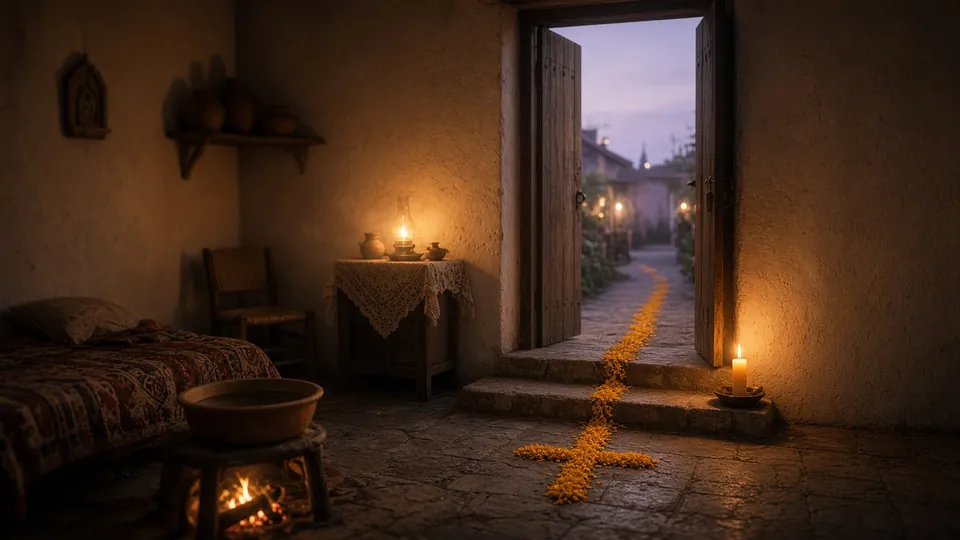
There's no single right way. An ofrenda can have one step or several, on a table or, in Mixquic's old way, on a woven reed mat called a petate. Saints, the Virgin of Guadalupe and a cross often stand at the back. Then come candles to light the way; a glass of water, because people say the dead are thirsty after the long journey; a dish of salt; copal incense in a clay burner; fruit, tamales and pan de muerto, the bread of the dead.
In Mixquic the children's things come first: sweets, milk and small clay toys, with white flowers. The next day come marigolds for the grown-ups, their favourite food and drink, perhaps mole or pulque, and a photograph. Sugar skulls carry names, papel picado flutters overhead, and a path of petals leads from the door. Afterwards the food is shared with the living, never wasted.
Why are there sugar skulls?
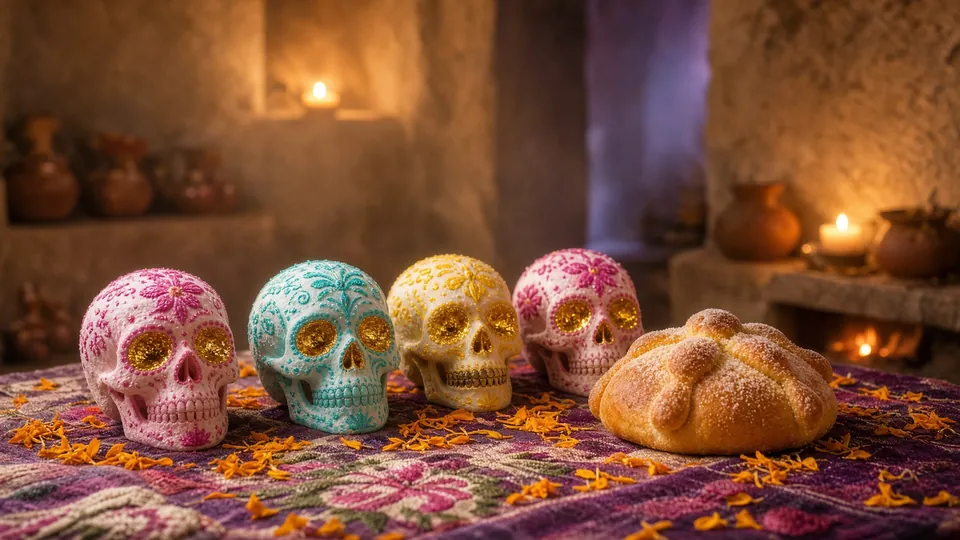
Sugar arrived with the Spanish, and so did alfeñique, a craft of shaping sweets from sugar paste that had reached Spain with the Moors of al-Andalus. In the 1760s the Capuchin friar Francisco de Ajofrín saw a thousand little sugar figures sold under Mexico City's merchants' arcade before All Saints: lambs and sheep, coffins, priests, nuns and gentlemen on horseback. There were no skulls in his list.
By the autumn of 1841, Frances Calderón de la Barca found the booths filled with sugar skulls, temptingly ranged in grinning rows, and old women calling, "Skulls, niñas, skulls!" Today sugar skulls with names piped across the forehead go on the ofrenda, and they're given to the living too, as a joke and a kindness at once. The city of Toluca holds a whole alfeñique fair every year.
Who is La Catrina?
She began as a joke about a hat. Around 1910 the printmaker José Guadalupe Posada drew a woman's skull under a huge hat piled with flowers and ostrich plumes, mocking people who tried too hard to look European and fashionable. The picture was first printed in 1913, after his death, on a broadsheet that called her a garbancera, a street seller of chickpeas; the verse wasn't his.
In 1946 and 1947 Diego Rivera put her at the centre of his mural Dream of a Sunday Afternoon in the Alameda, with a full body, a long white dress and a feathered serpent for a boa, holding Posada's arm. The name Catrina is usually credited to Rivera, though not everyone agrees. She isn't an ancient Aztec goddess, or Mictecacihuatl in modern clothes. She's a twentieth-century figure, and that story is interesting enough on its own.
What is the Alumbrada in Mixquic?
San Andrés Mixquic, an old lake town in Tláhuac on the southern edge of Mexico City, keeps a careful calendar for its dead. People say they are first invited on 29 September, when graves are cleaned and painted. Then, as the town's chronicler told a university researcher: 28 October for those who died by accident, 30 October for children who died before baptism, noon on 31 October for the other children, and 1 November for the grown-ups. On the evening of the first, children go from door to door as campaneros, ringing a hand bell.
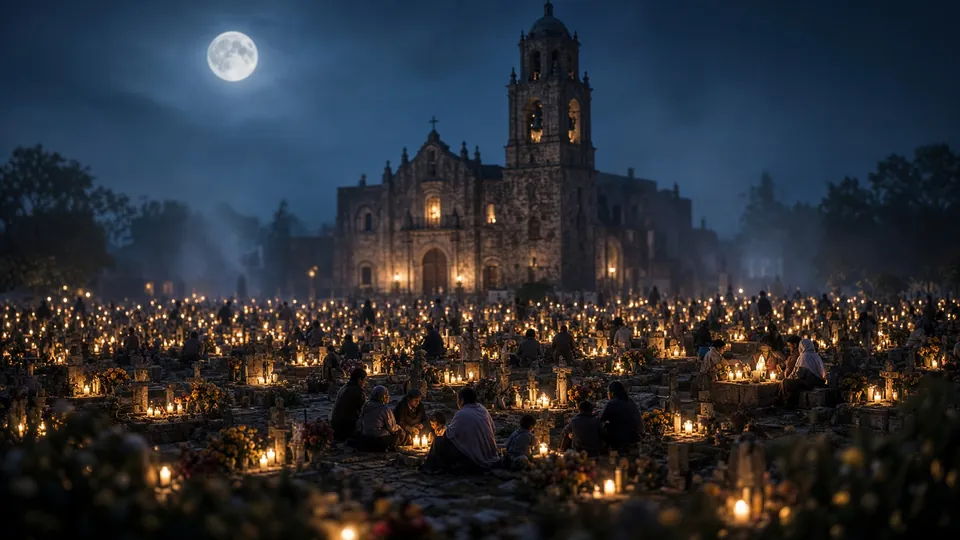
The Alumbrada, the lighting, is the night of 2 November. From about six in the evening until about midnight, families light candles on the graves around the old church of San Andrés, sit together, share coffee and bread, and tell stories. The next day they share out the ofrenda, which they call dar la calavera.
About this sleep story
About 2 hours 3 min. Slow narration, soft music, no loud sounds, nothing graphic, no ad breaks. Made as history to fall asleep to: it's fine to drift off partway, and the chapters below let you find your place again.
Día de Muertos is a living tradition, kept by millions of families and Indigenous communities across Mexico, so we've tried to tell it as theirs, with care. Mixquic and its customs are real; the families we meet there are imagined. Historians still discuss how much came from the Mexica world and how much from Spain; where sources disagree, the narration says so.
The narration voice is AI text-to-speech, from a script we research, write and fact-check, and the images are AI-generated artistic impressions, not historical records or photographs of real people.
Chapters
- 0:00:00Intro
Sugar skulls in Mexico City in 1841, a family altar at dusk, and the plan for the night: one real town, Mixquic, across five hundred years.
- 0:03:10An Island in Late Summer: Mixquic and Tenochtitlan
Around 1500, Mixquic is an island in Lake Chalco, ringed by chinampa fields. A grandmother and her grandson gather marigolds in Tlaxochimaco, the month of the giving of flowers.
- 0:12:29Two Months for the Dead: Mexica (Aztec) Festivals
The two Mexica calendars and the two summer months of the dead, the little feast and the great feast, seen through the friars who wrote them down. A home offering of tortillas, chocolate and copal.
- 0:19:38The Long Road to Mictlan, the Mexica Land of the Dead
Where the dead went: the house of the sun, Tlalocan, and the four-year road to Mictlan, ending at the river where a small yellow dog carries its master across.
- 0:26:53Ships, Friars and Two Holy Days: All Saints and All Souls Reach Mexico
Ships, the fall of Tenochtitlan in 1521, friars and epidemics. Augustinians dedicate Mixquic to Saint Andrew, and Spain brings All Saints and All Souls.
- 0:33:36A Colonial Village on All Souls
Around 1580, Ana takes candles, cacao and a little clay bird to her son's grave on the eve of All Saints, and comes back on All Souls for the grown-ups.
- 0:41:48What the Friar Saw
The friar Diego Durán sees offerings for children and adults on the two November days and wonders whether the old feasts moved inside them. The historians' debate, told fairly.
- 0:48:58Sugar Lambs and Sugar Skulls under the Arcades
Sugar-paste alfeñique, and the 1760s fair under Mexico City's merchants' arcade, with sugar lambs, coffins and tiny clergy, but no skulls yet. The first breads of the dead.
- 0:56:02Skulls, Girls, Skulls
Frances Calderón de la Barca's two Novembers: churches hung in black in 1840, and in 1841 booths of sugar skulls and a Noah's ark of sugar animals.
- 1:03:19A Town on the Night of the Dead
Mixquic in the 1870s: a stall of candles, marigolds and pan de muerto, the 1859 cemetery law, Don Juan Tenorio in the theatres, and comic calavera verses in the penny press.
- 1:10:42The Lady in the Big Hat: Posada and La Catrina
José Guadalupe Posada's skull lady in a plumed hat, first printed in 1913, and how Diego Rivera's 1946–47 mural made her La Catrina.
- 1:18:46The Night Becomes Famous
From the 1920s, Janitzio and the whole festival become national symbols. Chicano artists build public altars, UNESCO recognises the festivity, and Mixquic grows famous.
- 1:25:44Building the Ofrenda: A Day of the Dead Altar
Tonight's imagined family builds an ofrenda for a grandfather who died in the spring: saints, candles, water, salt, fruit, sugar skulls with names, and the children's things first.
- 1:36:04Marigolds (Cempasúchil), Copal and Papel Picado
Marigolds cut on the chinampas, a petal path to the door, copal smoke and papel picado cut in stacks. The church bell sees the children off and welcomes the grown-ups home.
- 1:43:13Elsewhere Tonight
Mixquic's campaneros ring hand bells from door to door. Then a slow look at Janitzio, Oaxaca, Yucatán's Hanal Pixán, Ocotepec and Mexico City's parade, new since 2016.
- 1:49:28The Alumbrada: Mixquic's Night of Candles
On the night of 2 November the churchyard fills with candles from about six until midnight. The family tells stories at the grave, and next morning shares out the ofrenda.
- 2:00:02Goodnight
A last look at the candlelit churchyard and the little sugar skulls, and a gentle goodnight.
Read the narration
The narration as it's spoken in the video, chapter by chapter, with the spoken channel notes (companions, comments) left out. People in the Mixquic story are imagined; the history around them is real.
0:00:00Intro · 330 words
In the autumn of 1841, a visitor walking under the arcades of Mexico City heard old women calling from their stalls, "Skulls, girls, skulls!" The skulls were made of sugar.
At dusk, beside the water, a family's altar glows: bright paper banners overhead, small candles, a carpet of orange marigold petals, and one large sugar skull, painted with flowers in orange, turquoise and pink.
This is Dreaming Ages. Over the next two hours, we'll walk the marigold paths of the Day of the Dead, Día de los Muertos, or simply Día de Muertos, from the old island town of Mixquic to a family's vigil tonight.
Nothing loud, nothing sudden. Just a slow voice, the smell of warm bread, and a great many small candles.
So settle in, and let your breathing slow.
It's the second evening of November, in San Andrés Mixquic, an old lake town on the southern edge of Mexico City.
Intro
The sky over the canals is turning from gold to violet. Along the lane to the church, people walk slowly with their arms full: bundles of orange flowers, covered baskets, a folding chair, a thermos of something hot.
Tonight we'll stay in this one town across five hundred years. We'll begin in a late summer when Mixquic was an island in a lake, and its people spoke Nahuatl. We'll watch the first church bells ring over the water, walk under the old arcades of the capital, and come back to a family keeping watch beside a grave.
When something is uncertain or imagined, I'll say so as we go.
This isn't a frightening story. It's about families remembering the people they've loved, and welcoming them home for a little while. Historians still discuss how much of it comes from the old Mexica world and how much came across the ocean. We'll hear both sides. Most agree it grew from both, and kept growing.
Now, let's go back five hundred years, to the same place, in late summer.
0:03:10An Island in Late Summer: Mixquic and Tenochtitlan · 1,260 words
It's early morning, around the year 1500, and a thin mist is lying on the water.
The lake here is called Chalco. It's shallow and fresh, fed by springs at the foot of the hills to the south. Far to the northwest, beyond more water and more towns, stands the great island city of Tenochtitlan, the heart of the Mexica world. From here you can't see it. You can see the mountains, though, which ring the whole valley like the rim of a bowl. And to the southeast, when the mist thins, two great volcanoes rise above everything, one often trailing a plume of pale smoke, the other long and white along its top, like a figure lying asleep.
Mixquic sits on an island in this lake. Its name is usually read as "at the mesquite tree", and in the old painted books its sign is a thorny mesquite. You may hear that it means "place of death", but that's a modern story. It's an old town, and for a long time its more powerful neighbours fought over it, one after another. Then, in the 1400s, in the reign of the Mexica ruler Itzcóatl, Mexica armies came. The painted books list Mixquic among his conquests. Since then, like the other conquered towns of the valley, it has sent tribute to Tenochtitlan.
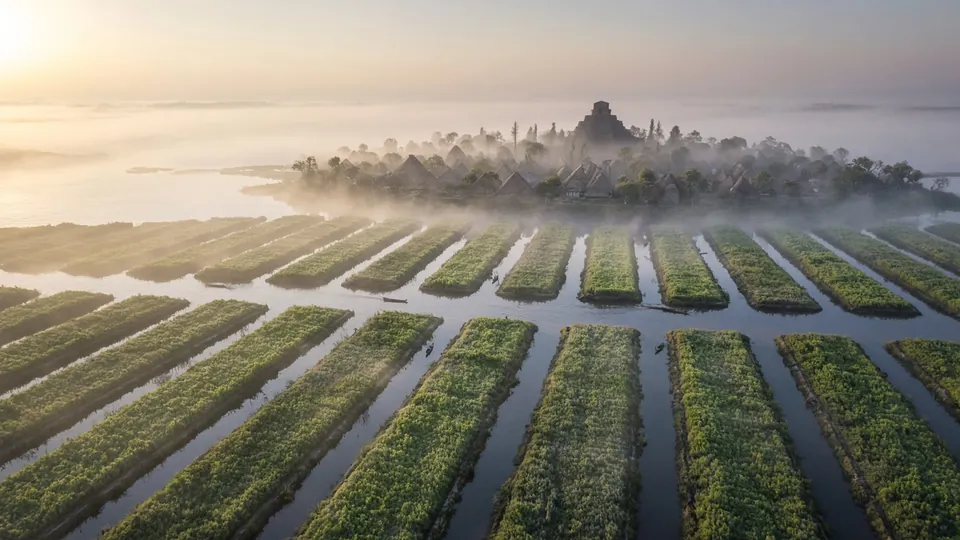
All around the island, the farmers have made fields out of the lake itself. They're called chinampas. Long, narrow beds of earth, built up from layers of mud and reeds and rotted plants, held in place by stakes and by the roots of willows planted along their edges. Between them run canals, straight and still, just wide enough for a canoe. From above, the whole island looks as if it's set in a great green comb laid on the water.
The chinampas are wonderfully rich. Their soil is always damp from below, and every so often the farmers scoop fresh black mud up from the canal bottoms and spread it over the beds. Here they grow maize, and beans, and squash, and chiles, and tomatoes, and amaranth, and flowers. Many, many flowers.
It's the rainy season now. For weeks, almost every afternoon, the clouds have built up over the mountains, dark and heavy, and then rolled across the valley in a long, drumming rain. By evening the sky clears, and the frogs start up in the canals. And in the mornings, like this one, everything is washed and cool, and the mist rises off the water in slow curls.
The maize is tall. Taller than a man, in the best beds, with long green leaves that rustle when the breeze comes off the lake, and tassels on top just turning pale. The cobs inside the husks are still young and soft. Harvest is a long way off yet.
Let's follow one canal, slowly, toward a house at the end of it.
It's a low house of adobe brick, plastered and whitened, with a roof of thatch. There's a little courtyard in front, swept clean, and a round, domed sweat bath to one side. Beside the door, a turkey is scratching in the dust. The family's canoe is tied up at the edge of the canal, a long dugout made from a single tree.
In the doorway sits an old woman, wrapped in a cotton mantle against the morning cool. Her name, in our story, is Citlalin. It means star. She's imagined, like everyone we'll meet in Mixquic tonight. She's a grandmother many times over, and she's lived beside this water all her life.
Beside her, half awake, is her grandson Tochtli. His name means rabbit, because he was born on a day of the Rabbit, and he's about ten. He's been told that today he can help her with something important.
Today the flowers have to be gathered.
The month that's beginning now has a lovely name. It's called Tlaxochimaco, which means something like "the giving of flowers". That name comes from a Franciscan friar, Bernardino de Sahagún, who spent decades, later in the 1500s, gathering what the Mexica could still tell him about their old festivals. His helpers wrote down that, at this time of year, people went out across the countryside looking for every flower they could find. Mountain flowers, water lilies, all kinds of flowers with names we can only guess at in English. And among them, again and again, a round, ruffled flower of deep yellow and orange.
In Nahuatl it's called cempoalxochitl. The word means "twenty flower", and people often understand it as "the flower of many petals". Today, in Spanish, it's cempasúchil. In English we'd call it a marigold. And in five hundred years' time, here in Mixquic, it will still be grown and sold by the armful, for the same season of remembering.
But we're getting ahead of ourselves. For now, it's just a flower Citlalin loves.
She stands, slowly, and Tochtli unties the canoe. She sits in the middle, and he takes the long pole and pushes off, the way his father showed him, leaning his weight into it and walking it back hand over hand. The canoe slides out along the canal without a sound.
The mist is lifting. Along the edges of the beds, white herons stand on one leg, watching the water. A kingfisher flashes past. In the next chinampa a man is already at work, bent over, his digging stick going in and out of the soft earth. He raises a hand to them. Citlalin raises hers back.
At the end of the family's own beds, beyond the maize, there's a long strip where the flowers grow. The marigolds are not yet at their fullest. Their great season comes later, as the rains end. But there are enough. Tochtli holds the canoe steady against the bank, and Citlalin leans out and picks them, one by one, laying them in a basket at her feet. The smell rises around them, sharp and green and a little bitter, unlike any other flower.
"Not too many from one plant," she says. "Leave some for later."
She picks other flowers too. White ones, and red ones, and pale yellow ones that grow at the water's edge. By the time the sun is fully up and the last of the mist is gone, the basket is heaped full, and Tochtli's arms are tired from the pole.
On the way home, they pass the temple of the town. It stands on a raised platform near the heart of the island, with steps up the front and a shrine on top. One day, a church will stand on this same ground. Already people are climbing those steps with flowers in their arms. Sahagún's helpers recorded that in the great city, the image of the Mexica patron god was decked with garlands of flowers at dawn, and then flowers were offered in the other temples, and in the houses of the lords. In a farming town like Mixquic, we can picture something humbler, in the same spirit. That part is imagined.
Back at the house, Citlalin sets the basket down in the shade, and sprinkles it with water from a jar, so the flowers will keep. Then she sits again in the doorway, and looks out at the canal, and the maize, and the mountains, as the morning warms.
Tochtli asks her why they need so many flowers this month.
She takes a long time to answer. And when she does, she doesn't talk about gods at all, at first. She talks about his grandfather.
0:12:29Two Months for the Dead: Mexica (Aztec) Festivals · 981 words
To understand why this month matters, we need to understand a little about time, as the Mexica kept it.
They had two great calendars, turning together like wheels. One was a sacred count of two hundred and sixty days, used for naming children and reading fortunes. Tochtli's name came from that one. The other was a year of three hundred and sixty five days, made of eighteen months of twenty days each, with five extra days at the end, which were thought to be unlucky. Nobody started anything new in those five days.
That solar year had no leap day. So, slowly, over many years, its months drifted against the real seasons, the way a clock drifts if no one ever winds it right. Historians have to work hard to say exactly when a given month fell. But in the year 1519, according to one careful reckoning, the two months we're talking about ran from late July to the end of August. High summer. The height of the rains. The maize growing tall.
And these two months, the ninth and the tenth of the year, were both connected with the dead.
The ninth month, the one that's beginning now in our story, had two names. One was Tlaxochimaco, the giving of flowers. The other was Miccailhuitontli. It's a long word, but it breaks into pieces. Micca means the dead. Ilhuitl means a feast day. And the little ending, tontli, makes it small. So it's the little feast of the dead. Or perhaps, the feast of the little dead.
That second meaning matters. A Dominican friar named Diego Durán, who grew up in New Spain and wrote about the old festivals in the 1570s, was told that this month was kept in memory of children who had died. The little dead. Then the next month, the tenth, was called Hueymiccailhuitl, the great feast of the dead. The feast for the grown-ups.
Scholars still discuss exactly what those names meant, and the old sources don't always agree. But it's a picture worth keeping in mind: a summer month for the children, and then a summer month for the adults.
What did people actually do? Here we have to be honest about where our knowledge comes from.
Almost everything we know about these festivals was written down after the Spanish conquest, mostly by Catholic friars like Sahagún and Durán. They were curious, and they were careful, and they talked to people who remembered. But they were also writing in order to root the old religion out. And by the time they asked, many of the priests who'd understood these rites most deeply were gone. So we see these festivals through a window that's a little cloudy, and that was made by people who didn't approve of what they saw.
Through that window, we see flowers. A great deal of flowers. Garlands and offerings in the temples. Feasting and singing and dancing. We see the tenth month built around a tall tree trunk, which was cut in the forest, carried into the city with great ceremony, and raised in a temple courtyard. A figure made of amaranth dough was set at the very top. At the end of the feast, young men raced each other up the trunk to bring the dough figure down, and the one who reached it first was greatly honoured. Durán says that a great amount of food and pulque, the milky drink made from the maguey plant, was laid around the foot of the pole.
These great festivals also included human sacrifice, as many Mexica festivals did. The friars describe it, and historians have studied it. We won't dwell on it here. It's part of the truth, and it's enough to say it plainly once.
For most families, in towns like Mixquic, the months of the dead would have meant something closer to home. We don't have a farmer's diary from the year 1500. Nobody wrote one. But we know from the sources that the dead were remembered with offerings, and that the living felt a duty to them. And in Citlalin's house, as the flowers wait in the shade, Citlalin is getting ready to do what grandmothers have always done.
In the corner of the main room, there's a low shelf against the wall, where the family keeps a few small clay figures, and a little bowl for burning incense. Today, Citlalin clears it, and wipes it down, and sets fresh flowers there. Then she lays out food. A few tortillas, still warm from the clay griddle. A small bowl of beans. A tamale wrapped in a corn husk. And a little cup of chocolate, frothed up the way her husband liked it.
Chocolate was precious in this world. The cacao beans came from far away in the hot lands to the south, and they were so valued that people used them as small change in the markets. A cup of it, poured out for someone who's gone, says a great deal.
Then she takes a pinch of pale resin from a small bag, and drops it onto a coal in the incense bowl. It's copal, the hardened sap of a tree, and it has been burned in offerings across this part of the world for a very long time. A thread of white smoke rises, and spreads, and the room fills with a sweet, piney scent.
Tochtli watches all this, sitting on a reed mat by the door.
"Will he come?" he asks.
"He'll know," says his grandmother.
Outside, the afternoon clouds are gathering over the mountains, as they do every day this time of year. Soon the rain will come, drumming on the thatch and dimpling the canals. But inside, the copal smoke drifts, and the marigolds glow orange on the shelf, and the little room is warm and dry and full of the smell of chocolate.
0:19:38The Long Road to Mictlan, the Mexica Land of the Dead · 1,003 words
That night, after the rain, the clouds break up, and a half moon comes out over the lake. Its light lies on the canals in long silver bars. The frogs are singing. The maize leaves drip.
Inside, the family is asleep on their mats, all except Citlalin, who sits by the hearth, where three stones hold the griddle over the last red coals. Tochtli is curled beside her, not quite asleep. And she tells him, in a low voice, about where the dead go.
What she tells him is drawn from what the Mexica told Sahagún, and from what historians have pieced together since. The details varied from place to place and from teller to teller, and we only have pieces. But the shape of it is this.
Where you went when you died depended less on how you had lived, and more on how you died.
Warriors who fell in battle, and those who died as offerings, went to the east, to the house of the sun. Every morning they walked with the sun as it rose, from the edge of the world up into the sky, singing and shaking their shields. After four years, the old accounts say, they came back to the earth as hummingbirds and butterflies, sipping from the flowers.
Women who died giving birth were honoured like warriors. They went to the west, and walked with the sun every afternoon, as it went down.
People who drowned, or were struck by lightning, or died of certain illnesses that were linked to water, went to a different place. It was called Tlalocan, the land of Tlaloc, the god of rain. And Tlalocan was a green and gentle country, where it was always summer, and the maize never failed, and there was no end to squash and beans and flowers.
But most people, the great majority of ordinary men and women who simply grew old, or fell ill, went somewhere else. They went to Mictlan, the place of the dead.
Mictlan lay far away, deep below, toward the north. It was ruled by a lord and a lady. The lord was called Mictlantecuhtli, the lord of the place of the dead. And the lady was Mictecacihuatl, the lady of the place of the dead. In the old stone carvings, they're shown as figures with fleshless faces. But they weren't thought of as cruel. They were the keepers of the dead, and the dead went to them in the end.
The road there was long. The old accounts recorded by Sahagún say that it took four years.
On the way, the dead had to pass a series of places. Two great mountains that knocked against each other. A road watched over by a serpent. Eight deserts. Eight hills. And a cold wind that cut like blades of obsidian, the black volcanic glass the Mexica used for their sharpest knives. Some later pictures show the land of the dead as nine levels, one below the other, while Sahagún's account reads more like a journey. The sources differ, and that's all right. Every family pictured it in its own way.
And at the end of the journey, the dead came to a broad river. Its name was Chiconahuapan, which means something like "the nine waters".
Here, Citlalin tells Tochtli, is where the little dog comes in.
When someone died, Sahagún writes, a small yellow dog was sent along with them, with a loose cotton cord tied around its neck. And when the dead person reached the great river, after their four years of walking, they would look across, and there, on the far bank, would be the dogs. And when a dog recognised its master, it would leap into the water and swim across, and carry them over on its back.
But not every dog would do. According to the story, a white dog would say, "I've just washed myself," and refuse to get wet. And a black dog would say, "I've just stained myself black," and refuse too. Only a yellow dog would carry you across.
Tochtli laughs at that, sleepily. Citlalin smiles.
Then she tells him the rest. While the dead person walked that long road, the family at home didn't forget them. At the funeral, the body was wrapped, and the things the dead would need were sent along with them. Then, at eighty days, the family made offerings again, and burned some of the person's belongings, so that they would reach them on the road. And they did it again after one year, and after two, and three, and four. On the fourth anniversary, it was believed, the journey was finally over. The dead had arrived. They were home, in their way.
Citlalin's husband died three years ago, in the dry season, of a fever. So this is the third summer she has made his offering. There's one more year to go.
She doesn't say this to Tochtli. She just watches the coals, and listens to the frogs, and to the water dripping from the thatch.
Historians would add a quiet note here. The four-year journey, the river and the yellow dog belong to the Mexica world, as Sahagún recorded it. The yearly visit home that families welcome today, with candles and bread and a path of petals, is a later story, where this world and another one, from across the ocean, meet. How much of that visit goes back to the Mexica, and how much came from Spain, is still discussed. We'll come to it.
For now, it's enough to sit here, by the three hearthstones, in a house on the edge of the lake, around the year 1500. The moon is high now. The flowers on the shelf are dark shapes against the night. The last thread of copal smoke has faded, but the scent is still there.
Tochtli is asleep. Citlalin lays a corner of her mantle over him.
Out on the lake, a heron calls once, low and hoarse, and then the night is still.
0:26:53Ships, Friars and Two Holy Days: All Saints and All Souls Reach Mexico · 914 words
Let's let the years turn.
The maize is harvested and planted again, and harvested again. Citlalin's offering is made for the fourth and last time, and then, one dry season, it's her family who make an offering for her. Tochtli grows up, and poles his own canoe, and has children of his own. The rains come every summer, and the frogs sing every night, and the herons stand in the mist.
And then, in the year 1519, strangers arrive on the eastern coast. They come in tall wooden ships, from a country called Spain, across an ocean nobody here has ever crossed. They have horses, which no one in this land has ever seen, and steel, and guns. Within two years, after a long and terrible war, and after a sickness the strangers brought with them had already swept through the valley, the great island city of Tenochtitlan has fallen.
We won't follow the war. It's been told many times, and it isn't a story for falling asleep. It's enough to say that in the summer of 1521, the Mexica world as Citlalin knew it came to an end, and a new one began, called New Spain.
In 1524, a small group of Franciscan friars arrived in the valley, twelve of them, in plain grey robes, having walked barefoot all the way up from the coast. More friars followed, Dominicans, and then Augustinians, in black habits. In 1536, or perhaps the year after, two Augustinian friars, Jorge de Ávila and Jerónimo de San Esteban, came to Mixquic, founded a house there, and dedicated it to Saint Andrew, the fisherman apostle. People say that suited a town of fishermen. That's why, ever since, the town has been called San Andrés Mixquic.
All over the valley, the friars learned Nahuatl. They built churches and schools. And they set about, with complete conviction, replacing the old religion with their own.
That meant destruction, too. The first bishop of Mexico wrote in 1531 that hundreds of temples had been pulled down, and many thousands of sacred images broken or burned. Painted books were burned as well. It's one of the reasons we have to look at the old festivals through such a cloudy window. Much of the evidence was deliberately destroyed.
And there was a second sorrow, quieter and much larger. The newcomers brought diseases that the people of this land had never met, and had no defence against. Smallpox. Measles. And later in the century, great waves of a fever the Mexica called cocoliztli, in the 1540s and again in the 1570s. Historians still argue over the numbers. But the losses were enormous. In some towns, more people died in a few years than anyone could bear to count.
So, in the decades after the conquest, death was very close to everyone here. Every family had people to remember.
And the friars brought with them a way of remembering the dead that had grown up, over centuries, on the other side of the ocean.
In the Catholic year, the end of October and the start of November were a holy season. 1 November was the feast of All Saints, for all the holy people in heaven. And 2 November was All Souls, for everyone else. For all the ordinary dead, whom Christians prayed for, believing that their prayers could help the souls of the departed on their way to God.
All Souls had begun about a thousand years ago, at the great abbey of Cluny in France, when its abbot, Odilo, ordered his monks to pray for all the faithful departed on the day after All Saints. Over the next two centuries, the custom spread across Europe. By the time of the conquest, it was one of the best loved days of the year in Spain.
What did people in Spain do on these days? They went to Mass. The churches were hung with black. Bells were rung for the souls of the dead, often far into the night. And families took offerings to the church and to the graves. Bread, and wine, and candles, laid out in memory of the people they had lost. In many parts of Catholic Europe, people believed that on the night of All Souls, the dead came back for a little while to the homes they had known. Some families left food out, or a lamp burning, or the table laid.
The friars brought all of this. The bells, and the candles, and the bread, and the two holy days at the beginning of November. They also brought the habit of burying the dead close to the church, inside its walls or in the courtyard in front of it, so that the living would pass by their graves every time they came to pray. That was new here. Before, many families had buried their dead under the floors of their own houses, or close by, where they could keep them near.
Which means that in this valley, in the years after the conquest, two worlds met that both, in their own ways, made offerings to the dead. One had kept its feasts of the dead in the high summer, with flowers and food and copal smoke. The other kept them at the start of November, with candles and bread and bells.
What happened when they met is one of the most discussed questions in all of Mexican history. We'll come to the discussion. First, let's go back to Mixquic, and see.
0:33:36A Colonial Village on All Souls · 1,114 words
It's the last evening of October, around the year 1580.
Mixquic is still an island. The canals are still here, and the chinampas, long and green, and the willows along their edges. The volcanoes still stand to the southeast, catching the last of the light. But something new rises above the low roofs now.
On the old raised platform, where the temple once stood, there's a church now, and beside it the friars' house, finished some twenty years ago. It's built of stone, with thick walls and small high windows. We don't know exactly how it looked in these years, because early in the next century an earthquake will bring most of it down, and only the bell tower will survive. But we know its plan: the church, the friars' house, and in front of them a wide walled courtyard, called the atrium. In the tower hangs a bronze bell.
It's dusk. The sky over the lake is pink and gold, and the water holds it like a mirror. The smoke of evening fires rises straight up from the houses, because there's no wind. The rains ended weeks ago. The days are warm and clear now, and the nights are cool. The maize stands dry and pale in the fields, ready for the harvest.
In one of the houses, by a canal, a woman is getting ready.
In our imagined story, her name is Ana. That's the name she was given at baptism, in the new church. Her mother, who has died, used to call her by an older name too, a Nahuatl name, and sometimes, inside her own head, Ana still hears it. She's about thirty. Her husband is out in the fields, finishing the day's work.
Two years ago, when the great fever came back, Ana lost her little son. He was four.
She doesn't talk about it much. But tonight, on the eve of All Saints, she's preparing something for him.
On a reed mat on the floor, she has laid out what she'll carry to the church. Two small candles of yellow beeswax, bought with care in the market, because wax isn't cheap. A handful of cacao beans. A little bundle of tortillas, wrapped in a cloth. Some fruit: a few guavas, and a sweet yellow sapote. And a small clay whistle, shaped like a bird, that her son used to blow until everyone in the house begged him to stop.
She wraps them all carefully in a cloth, and ties the corners.
Then the bell begins to ring.
It's a slow single bell, rung again and again, and its voice carries out across the roofs and the canals and over the still water of the lake. In Spain, on these nights, the bells rang for the souls of the dead, and the friars have brought the custom here. Across the town, people stop what they're doing for a moment, and look toward the church.
Ana picks up her bundle, and lights a small torch of pine at the fire, and goes out into the lane.
Others are walking the same way. Women with bundles. Old men with walking sticks. Children holding their mothers' hands. Nobody says much. The torches bob along the lanes, and gather at the gate of the atrium, and pass through.
Inside the walls, the courtyard is quiet. This is where the town now buries its dead. There are no headstones, just low mounds and a few simple wooden crosses. But everyone knows where their people lie.
Ana finds the place, near the wall, where her son is buried. She kneels, and spreads her cloth on the ground, and unwraps her bundle. She sets the two candles upright in the earth, and lights them from her torch. Then she lays out the cacao, and the tortillas, and the fruit, and last of all, the little clay bird.
All around her, other families are doing the same. Small lights spring up, one after another, across the dark courtyard, until it's dotted with them, like a field of low stars.
Ana sits back on her heels, and prays, the way the friars taught her, for her son's soul. And she talks to him a little, too, quietly, in Nahuatl, the way her own mother would have done.
High in the belfry, the old sacristan is ringing the bell. We can imagine him, in our story, a thin patient man who's rung this bell every All Saints since it was first raised. He pulls the rope, and lets it rise, and pulls again. Below him, the little lights flicker in the atrium. Beyond them, the lake is dark and wide, and the stars are out.
The next day, 1 November, the feast of All Saints, there's a great Mass in the church. And the day after that, on All Souls, Ana comes back to the atrium, this time with her husband, and they bring more offerings. This time, they're for her mother and father, and for his parents, and for all the grown-ups they've lost. A hen, plucked and cooked. Tamales. Seeds. More candles.
That morning of All Souls is soft and grey, with a little mist lying on the canals, the way it does now that the nights are cooler. The church is hung with black cloth inside. The friar, an Augustinian in his black habit, says the Mass for the dead, and afterwards he preaches, in Nahuatl, because that is the language everyone here speaks. The friars worked hard at it. Some of them, especially the Franciscans, wrote whole books of Christian songs in Nahuatl for the feasts of the year. One such book, made under Bernardino de Sahagún, the same friar who recorded the flower month, was printed in Mexico City in 1583.
After the Mass, the families go out into the atrium again, and the courtyard is full of quiet voices. Here and there, someone is crying. Here and there, someone is laughing at a memory. An old man is telling a story about Ana's father, who once fell out of his canoe in front of the whole town, and three or four people who remember it are smiling. The children run between the graves, and nobody minds.
When the offerings have stood for a while, the families gather them up again, and take them home, and share them. Nothing is wasted. The dead, people say, have taken what they need from it.
The first day for the children. The second for the grown-ups.
Ana doesn't think of this as anything unusual. It's simply what people do here. But a friar, writing at almost exactly this time, noticed it. And it puzzled him very much.
0:41:48What the Friar Saw · 984 words
His name was Diego Durán. He was born in Seville, in Spain, around 1537, but he was brought to New Spain as a small child, and grew up in Texcoco and in Mexico City, among people who spoke Nahuatl. He became a Dominican friar. And in the 1570s and early 1580s, he wrote long books about the history, the gods and the old calendar of the Mexica, so that his fellow priests could recognise the old religion if they saw it.
In the part of his work about the calendar, he describes the ninth month, Miccailhuitontli. He says the name means "the little feast of the dead", or "the feast of the little dead", and that as far as he could learn, it was a feast for children who had died. And then he adds something from his own experience.
On All Saints' Day, he writes, there's an offering in some places. And on All Souls' Day, another. He asked why they made it on All Saints, and people told him: for the children. That was how it was done in the old days, they said, and the custom had stayed. And would they offer again on All Souls? Yes, they said. For the grown-ups.
And so they did. Durán writes that he saw it plainly: the feasts of the dead, the little and the great, being kept. On one day, people offered money, and cacao, and wax, and birds, and fruit, and seeds in great quantity, and things to eat. And on the next day, he saw them do the same again.
Then he adds a careful, rather troubled sentence. Even though this feast used to fall in August, he says, what he imagines is this. If there's any pretence in it, which he won't dare to affirm, people have moved it to the feast of the Saints in order to disguise it.
It's a remarkable moment. A friar, around the year 1580, sees exactly what Ana does in Mixquic, in our story: an offering for the children on 1 November, and one for the grown-ups on the second. He wonders whether the old summer feasts of the dead have quietly moved inside the new Catholic days. And he isn't sure.
He wasn't the only one to notice offerings at graves. In another part of his work, Durán describes a later month, called Quecholli, when people made little arrows, tied in fours with four small pine torches. They set them on the graves of the dead with two tamales, and left them there for a whole day before burning them at night. That month, in the wandering calendar, could fall in late October and November. But we should be careful not to make too much of that. The old months moved, and Durán was describing the Mexica past, not the colonial present.
Historians have been turning Durán's sentence over ever since.
Some read it as evidence that something of the old feasts survived. The split that Durán saw, children on 1 November and grown-ups on the second, is still kept across much of Mexico today. In most of Catholic Europe, 1 November is simply for the saints. So perhaps, they suggest, the memory of a feast for the little dead and a feast for the great dead found a new home on the old days of the Church.
Others point out how much of what we now call the Day of the Dead looks very like what people did in Spain. Food set out for the dead. A favourite dish for someone especially loved. Candles at the graves. A path marked with flowers so the souls could find their way home. Bread and sweets in the shapes of bones. One Mexican historian, Elsa Malvido, founded a workshop on the history of death at the national institute of anthropology and history. She argued that almost all of it could be traced back to medieval Catholic Europe, and that the idea of a mainly Aztec festival was largely a twentieth century story. Others, like the art historian Ruben Cordova, take a middle path. The candles, the wheat bread, the sugar and the churchyards came from Spain, he writes. But some memory of the two old months may well survive, in that quiet division between the children and the grown-ups.
There's one thing nearly everyone agrees on. The old story, often repeated, that kind-hearted priests deliberately moved the Aztec festival to November, to make conversion easier, has no real evidence behind it. The friars weren't trying to keep the old feasts. They were trying to end them. If anything of the old ways survived, it was because ordinary families kept what they could, quietly, inside the new forms.
And perhaps that's the kindest way to put it. Two peoples, both of whom made offerings for their dead, met under very unequal and often painful circumstances. Over generations, in towns like Mixquic, their ways of remembering grew into each other, until no one living could easily say which part came from where. Ana wouldn't have been able to tell you. She would simply have said: this is what we do for our dead.
Today, UNESCO recognises the Day of the Dead as an Indigenous festivity, as it's practised by the Indigenous communities of Mexico, and describes it as a fusion of pre-Hispanic rites and Catholic feasts. Both halves of that sentence are true. The families who keep it don't need the historians to settle it.
Back in the atrium at Mixquic, on the night of All Souls, the candles are burning down. Ana's husband has gone home to see to the animals. She stays a little longer. The bell has stopped. The lake is quiet. Somewhere, a dog is barking at the moon, and then it stops too.
She gathers up the cloth, and the little clay bird, and walks home along the canal, under the stars.
0:48:58Sugar Lambs and Sugar Skulls under the Arcades · 963 words
Let's move forward again. Nearly two hundred years.
Many things that were new in Ana's time are ordinary now. Wheat grows in the valley alongside the maize, and there are bakeries in every town, with big domed ovens. Cattle and sheep graze on the hills. And in the warm valleys to the south, toward the hot lands, there are great fields of sugar cane, and mills where the cane is crushed. The juice is boiled down, and the sugar poured into clay moulds to harden.
Sugar arrived with the Spanish. It changed the way people celebrated almost everything, and it changed these November days most of all.
In Spain, there was an old craft of shaping sweets out of a pliable paste of sugar. It had come to Spain long before, with the Moors of al-Andalus, and it had an Arabic name: alfeñique. In New Spain, where sugar was plentiful, alfeñique flourished. The nuns in the city convents became famous for it, and so did ordinary sweet-makers in the markets, working with melted sugar and simple clay moulds.
And now, let's go into the capital, Mexico City, built on the ruins of Tenochtitlan. It's the eve of All Saints, in the 1760s.
In the great main square, the Plaza Mayor, there's the cathedral, huge and grey, still unfinished after nearly two centuries of building, its bell towers not yet complete. And along one side of the square runs a long arcade of stone arches, called the Portal de Mercaderes, the merchants' arcade. In the shade of its arches, every day of the year, there are shops and stalls.
But tonight, the arcade has been transformed.
We know what it looked like, because a Capuchin friar from Spain, Francisco de Ajofrín, travelled through New Spain in these years and wrote it down in his diary.
Before the day of the dead, he writes, they sell a thousand little figures of sheep and lambs and the like, made of alfeñique. People call them the ofrenda, the offering, and it's a gift that you simply must make to the little boys and girls of the houses you know. They sell coffins too, he writes, and tombs, and a thousand little figures of the dead: priests, friars, nuns of every order, bishops, gentlemen on horseback. And the great market and colourful fair for all of it is under the merchants' arcade, where the crowds of ladies and gentlemen of Mexico, on the eve and the day of All Saints, are past believing.
Let's walk under those arches, in our imagination, on that evening.
The light comes from candles and lanterns, set on the stall tables and hung from the stone. It falls on rows and rows of tiny white figures. Little lambs curled up as if asleep. Sheep with curly fleeces picked out in sugar. Miniature coffins, no longer than your finger, some with a tiny sugar figure lying inside. Tiny bishops in their tall hats. Nuns in their habits. A gentleman on a horse, no bigger than a walnut.
A mother in a dark shawl bends over a table, choosing a lamb for her neighbour's little girl. A boy stands with his nose almost touching a row of sugar horsemen, until his father slowly draws him away. Two ladies in fine silk walk arm in arm, fanning themselves, though the night is cool. A friar in brown passes by, and smiles at the sugar friars on the table.
Notice what isn't here. In Ajofrín's long list of figures, there are no skulls. The sugar skull, which today is perhaps the most famous sweet of the Day of the Dead, doesn't appear in his account. It may have existed, but it wasn't yet the star of the show. Those figures of lambs, and coffins, and little dead clergymen, belong to the same playful, tender tradition that would one day give us the sugar skull. But that day hadn't quite come.
Bread was changing too.
Wheat had come from Spain, and so had the habit of baking special breads for feast days. Elsa Malvido, the historian we met in the last chapter, describes breads sold near the cathedral at this season in colonial times. Some were shaped like little children and dusted with pink sugar, and some were round, with bones of dough laid around them. Those round loaves are the ancestors of the bread that families still bake, and buy, and lay on their offerings today: the pan de muerto, the bread of the dead.
And out in Mixquic, on its island, the season is kept in a simpler way. There's no great fair here. But somewhere in the town an oven has been lit since before dawn, and the smell of warm bread drifts across the lanes. A few families have bought a small sugar lamb or two from a travelling seller, for the children. In the church atrium, there are candles on the graves again, as there have been every year since Ana's time. And on the first evening of November, at the little altars inside the houses, among the saints' pictures, there's bread, and fruit, and a cup of chocolate, and a candle for each of the family's dead.
Ana herself is long gone now. She lies in the atrium, near her little son. And on All Souls, one of her great-great-grandchildren, without knowing quite why, always lights a candle in that corner of the wall.
In the capital, under the arcades, the crowds thin out as the night goes on. The stallholders cover their tables with cloths. The candles are blown out, one by one. A last lantern swings in the doorway of a closed shop, and goes out.
The sugar lambs sleep in their rows, under their cloths, waiting for the morning.
0:56:02Skulls, Girls, Skulls · 982 words
The years go on. New Spain becomes Mexico.
In 1821, after more than ten years of war, Mexico wins its independence from Spain. The viceroys are gone. There's a president now, and a congress, and a new flag over the square. But the bells still ring on All Saints, and the candles are still lit in the churchyards, and the sugar is still shaped into little figures for the children.
Late in 1839, a Scottish-born woman arrived in Mexico City with her Spanish husband. Her name was Frances Erskine Inglis, but the world came to know her by her married name, Madame Calderón de la Barca. Her husband was the first ambassador sent by Spain to independent Mexico. And for two years, she wrote long lively letters home, about everything she saw. In 1843 they were published as a book, called Life in Mexico. It's still one of the most vivid pictures we have of the country in those years.
She was there for two Novembers. And she wrote about both.
On 3 November, 1840, she wrote from a country estate outside the city, where she and her husband had travelled for a week. Yesterday, she says, 2 November, was a day that for eight centuries has been set apart in the Catholic Church for remembering the dead. The day "emphatically known," as she puts it, "as the Día de Muertos."
She describes the churches all across the Republic, darkened and hung with black cloth. In the middle aisle of each one, she says, stands a coffin, also covered in black, and painted with skulls and other reminders that everyone must die. Everyone goes to church in mourning. And she adds, rather movingly, that there's perhaps not one heart in the whole Catholic world which isn't wrung that day, in calling up the memory of the departed.
On their way out of the city, she and her husband stopped to hear Mass at a country church. It was crowded, she writes, with poor people, and the priests were Indigenous men with bare feet. The building itself was large and rich, hung with black cloth, and lit with great tapers, whose light fell on as much of the gilding on the walls as the dark drapery left showing.
Let's stay in that church for a moment, in our imagination. The morning light comes in through high windows and falls in long dusty beams across the nave. The black cloth hangs in heavy folds over the gold. The tapers burn tall and steady, with a faint smell of wax. The people kneel on the stone floor, women with dark shawls over their heads, men holding their hats in their hands. And in the aisle, the black catafalque stands, an empty coffin that stands for everyone's dead at once.
A year later, in the autumn of 1841, the Calderóns were back in the capital, getting ready to leave Mexico for good. And on the evening of All Saints, she went out with friends to see the city.
They walked out under the portales, the arcades around the great square, the same arcades where the friar Ajofrín had seen the sugar lambs eighty years before. She'd come to see the illuminations, the hundreds of small lights set out along the arches, and the stalls.
And here, at last, are the skulls.
The booths, she writes, were filled with sugar skulls, temptingly ranged in grinning rows, "to the great edification of the children." It was a cool, rather disagreeable evening, she admits. Normally, there were crowds of well-dressed people at this festival, but that night, though there were a good number of ladies, they were wrapped up in shawls, and went home early.
But the old women at their booths kept up the cry, in their cracked voices: "Skulls, niñas, skulls!" Niñas means girls. It's the way a market woman might call out to any young lady passing by. Skulls, girls, skulls!
And there weren't only skulls. There were animals made of sugar, she says, of every kind. Enough of them to fill a Noah's ark.
Let's stand in that arcade, on a cool November evening, 1841. Small lamps flicker along the arches. There's a warm smell of cane sugar in the air, and the soft murmur of voices under the stone. On a trestle table, in rows, sit dozens of small white sugar skulls, each one about the size of a child's fist, with round dark eyes, and a little smile. Beside them, a parade of sugar animals marches across the table: lambs and donkeys, dogs and roosters, a sugar bull with tiny horns, a pair of sugar doves.
Behind the table sits an old woman in a dark rebozo, wrapped up to the chin. She's sold sweets here every All Saints for longer than she can remember. A little girl stops and points, and her mother laughs and reaches into her purse. The old woman wraps a skull in a twist of paper, and hands it over, and the little girl holds it in both hands as if it were made of glass.
Notice how ordinary it all is. Nobody here is frightened of these little skulls. They're sweets. They're a treat. They're a small, slightly comic reminder of something everyone knows: that one day, every one of us will be a skull too. And on this evening of all evenings, that thought is held lightly, and wrapped in paper, and given to a child.
The evening grows cooler. The ladies pull their shawls tighter and drift home. The old women begin to cover their tables. Somewhere across the square, the cathedral bells ring the hour.
Madame Calderón goes back to her lodgings, and some days later writes it all down. And so, almost two hundred years later, we can still hear those cracked old voices calling out across the dark arcade. Skulls, girls, skulls.
1:03:19A Town on the Night of the Dead · 998 words
Let's go back to Mixquic, a little later in the century. It's the 1870s, and 1 November.
The town has changed again, though it's still an island, and the canals are still its roads. Early in the 1600s, an earthquake brought down the old church and the friars' house, all but the bell tower. They were rebuilt, and since about 1620 the front of the church has been faced with dark volcanic stone, picked out in red. In these years, men from the lake towns still pole their canoes, loaded with vegetables and flowers, along the waterways to the markets of the capital.
And near the church, on this first afternoon of November, there's a stall.
It belongs, in our story, to Doña Refugio. She's in her fifties, round and quick and kind, and every year at this season she sells the things people need for their dead. Bundles of candles, tied with string, thin ones and thick ones. Bunches of marigolds. Little dishes of sweet paste made from tejocote, a small golden fruit like a crab apple. And, most important of all, bread.
Doña Refugio's sister bakes bread, and for three days the oven has hardly been allowed to cool. The loaves are round and golden, brushed with egg, and on top of each one lie crossed strips of dough, shaped like little bones, with a round knob in the middle. They're dusted with sugar, and they smell of orange blossom and butter. This is pan de muerto, the bread of the dead.
A Mexican writer of these years, Guillermo Prieto, remembered how, at this season, the bakeries sold the bread of the dead in almost unbelievable quantities. They sold it along with tejocote jelly and sugar figures, for every kind of household, rich and poor alike. It was, he suggested, a day of tears, but also a day of a great many small pleasures.
People stop at Doña Refugio's stall all afternoon. A young widow buys two thick candles and a loaf. An old man buys marigolds, and then, after some thought, a small dish of tejocote paste, because his wife always loved it. A boy is sent running from his house with a coin clutched in his fist, to buy one more candle because his grandmother has remembered another cousin.
Something else has changed, too, in these years. Something to do with where the dead lie.
In 1859, during a long struggle between the government and the Church, President Benito Juárez issued a law that took the cemeteries out of the hands of the clergy and placed them under civil authority. Civil cemeteries were to be set up, and over time, in many towns, new burial grounds were laid out a short way outside, with a wall around them and a gate that could be closed.
In Mixquic, though, the dead are not far away. Today, the graves still lie close around the old church, so that the church seems to stand in the middle of its cemetery. Some graves have painted wooden crosses, and some have headstones carved with names, and every family knows its own.
In the theatres of the capital, at this time of year, the companies always put on the same play. It's called Don Juan Tenorio. A Spanish writer, José Zorrilla, wrote it in 1844, and it tells the story of a famous seducer who is saved, at the very end, by the love of a woman he once wronged. It has a scene in a moonlit graveyard, among the statues of the dead. Ever since, in Spain and in Mexico, theatres have staged it around All Saints and All Souls. People who have seen it every year since childhood, still go, and mouth the famous lines along with the actors.
And in the little print shops of the cities, in these years, another tradition is growing up.
Around the Day of the Dead, cheap newspapers and penny broadsheets began to print funny verses called calaveras. Calavera means skull. These were mock epitaphs, little poems that imagined well-known people, politicians, priests, rich men, actors, already dead and buried, and poked fun at their habits and their vanities. They were sharp, and silly, and sometimes daring, and people loved them. They were printed on cheap coloured paper, pink and green and yellow, and sold in the streets for a few cents.
That tradition is still alive today. Newspapers still print calaveras every November. Schoolchildren still write them for class, little rhyming poems about their teachers and their friends meeting death, and laughing about it.
As the afternoon fades, Doña Refugio's stall is almost empty. A few candles left. Half a loaf. She packs them away into a basket. Her nephew, a tall young man of eighteen, comes to help her carry the trestles home.
That evening, in her own small house, she sets up her altar on the table by the wall. A white cloth. A picture of the Virgin. Two candles for her parents, and one for her husband, and a small one for the baby she lost many years ago. A loaf of the bread of the dead, the best one, which she saved. A dish of tejocote paste. A glass of water. A few marigolds in a jar.
She lights the candles, one by one. She sits for a while in the warm, flickering light. She talks to them a little, under her breath, the way she does every year. She tells her mother that the bread sold well. She tells her husband that the roof still leaks over the door, just as he said it would. She tells the baby nothing, but she looks at the small candle for a long time.
Outside, the town is quiet. Here and there in the dark, other windows glow, small and gold, where other families are doing the same. Over by the church, a few lanterns are moving, slowly, where someone has gone to light a candle on a grave.
1:10:42The Lady in the Big Hat: Posada and La Catrina · 1,065 words
Now let's go into the city, to a small crowded print shop near the old centre, at the turn of the century.
The room smells of ink and oil and paper. There's a heavy iron press in the middle, and stacks of cheap coloured paper on the shelves, and long strings across the ceiling where freshly printed sheets hang to dry. At a bench by the window, where the light is best, a heavy-set man with a moustache is bent over a metal plate, working on a drawing.
His name is José Guadalupe Posada. He was born in Aguascalientes in 1852, and he's been making pictures for printers all his working life. Now he works for a publisher in Mexico City named Antonio Vanegas Arroyo, who prints all kinds of cheap broadsheets: songs, prayers, ghost stories, news of crimes and disasters, games for children, and, every November, sheets of calaveras.
Posada has made thousands of images for them. Many of his most famous ones are skeletons. Skeletons dancing, skeletons riding bicycles, skeletons selling newspapers, skeletons playing guitars at a party. Skeletons dressed as dandies, as generals, as housewives, as market vendors. They're lively, comic and full of movement, and they're meant to make people laugh. The verses printed beside them were written by others. But the pictures were his.
Around the year 1910, Posada drew a small picture of a woman's skull, wearing a hat.
It's a very large hat. An enormous wide fashionable hat of the kind that wealthy ladies in Paris and New York and Mexico City were wearing at the time, piled with flowers and topped with two great ostrich plumes. Beneath the hat, there's just a grinning skull, and the bones of the shoulders. That's all.
The picture was a joke about vanity, and about people who tried too hard to look European and fashionable. Underneath all the plumes and the finery, it says, we're all the same in the end.
Posada died in January 1913. The first printing we know of that picture came later that year, on a Day of the Dead broadsheet that called the lady a garbancera. A garbancera was a woman who sold chickpeas in the street. The verse beside the picture mocked such women for powdering their faces and dressing above their station. It wasn't a kind verse, and it wasn't Posada's.
For many years, the picture was just one among thousands.
Then, in the 1920s and thirties, Mexican artists began to rediscover Posada. After the long upheaval of the Mexican Revolution, they were looking for a truly Mexican art, an art of the people, and they found it in his cheap lively prints. They began to call him the father of modern Mexican art.
One of those artists was the great muralist, Diego Rivera.
In 1946 and 1947, Rivera painted an enormous mural for a hotel in Mexico City, beside the Alameda park. It's called Dream of a Sunday Afternoon in the Alameda. It shows a crowd of figures from Mexican history, all strolling together through the park on a single dreamlike afternoon. And at the very centre of it, he painted the skull lady in the big hat.
But now she has a whole body. She wears a long white dress. Around her shoulders, instead of a fashionable boa, there's a feathered serpent, the old Mesoamerican symbol. On one side, she holds the arm of Posada himself, in his dark suit and bowler hat. On the other, she holds the hand of a small boy, who is Rivera as a child. And behind the boy stands the painter Frida Kahlo.
Rivera turned the joke into something else. A satire of fashionable vanity became a warm strange dignified figure, a kind of grand dame of Mexico, standing between the artist who first drew her and the artist who gave her a body. And the name by which almost everyone knows her now, La Catrina, is usually credited to Rivera himself, though not everyone agrees, and the word was around long before him. A catrín was a dandy, an overdressed gentleman. And a catrina was his fashionable lady.
The mural itself has had its own adventures. When a great earthquake struck Mexico City in 1985, the hotel was badly damaged. The huge painted wall was moved, carefully, in one piece, to a small museum of its own nearby, where you can still see it today.
And La Catrina is everywhere now. Painted on walls and pottery. Carved in wood. Made of papier mâché, in every size, from a doll to a figure taller than a house. Shaped in sugar, and clay, and tin. People dress as her, with painted faces and wide flowered hats.
It's worth saying clearly, because it's often said otherwise, that La Catrina isn't an ancient Aztec goddess. She isn't the Lady of the Dead, Mictecacihuatl, in modern clothes. She's a twentieth century creation, born from a printmaker's joke about a fashionable hat and raised into a national symbol by a muralist. That story is interesting enough on its own.
Let's picture, for a moment, one of those November mornings in the city, around the year 1900. A boy is walking through the crowded streets near the market with a bundle of broadsheets under his arm, still smelling of fresh ink. They're printed on thin bright paper, pink and green and orange. Across the top of each one is a picture of skeletons, dancing or drinking or riding a tram, and beneath it, columns of comic verse. He calls out as he goes, and people stop him, and hand over a coin, and stand on the corner reading, and laughing, and pointing out the jokes to one another. A street sweeper buys one. A clerk on his way to the office buys one. A woman with a basket of vegetables on her arm buys one for her husband. Most of them have no idea who drew the pictures. They only know they're funny.
Back in the print shop, in our imagination, the late afternoon light is going golden on the window. Posada sets down his tools, and wipes his hands on a rag, and holds the little plate up to the light. Then he puts on his coat and hat, and goes out into the noisy street, where the newspaper sellers are calling, and the trams are rattling past, and walks home.
1:18:46The Night Becomes Famous · 918 words
In the 1920s, the Day of the Dead began to be noticed in a new way.
Mexico was coming out of the long years of revolution, and its new governments, and its writers and artists, were searching for what it meant to be Mexican. More and more, they looked toward the country's Indigenous peoples, and their crafts, and dances, and festivals, as the heart of the nation. The word for this movement was indigenismo.
West of the capital, in the state of Michoacán, there's a large beautiful lake, called Pátzcuaro, ringed with hills and pine woods, and dotted with small islands. The people of its shores are Purépecha, with their own language and their own long history. And on the little island of Janitzio, steep and crowded with houses, the families have long kept a night vigil in their cemetery on the night of the dead. They bring candles and flowers, and food laid out on the graves.
In the 1920s, government officials came to see it. Photographers came, and writers. Pictures and articles appeared in newspapers and magazines, read by artists and anthropologists in Mexico and abroad. Lázaro Cárdenas, who was governor of Michoacán and later became president of Mexico, championed the region, and a huge statue of the independence hero José María Morelos was built on the top of Janitzio, looking out over the lake. Before long, visitors were coming from the capital, and then from further away, to see the Night of the Dead on Lake Pátzcuaro. By the 1940s, it had become one of the most famous sights in Mexico.
A historian of dance and performance, Ruth Hellier-Tinoco, has written about how the vigil, and a dance called the Dance of the Little Old Men, came to be presented as symbols of authentic Mexico in these years. Some things were staged for visitors. The fishermen of the lake, with their big butterfly-shaped nets, became famous in photographs, and the display of those nets is still performed for visitors today. But the family vigil in the island cemetery was, and is, real. It's simply that it became famous too.
The same thing happened, slowly, to the whole festival.
The government promoted the Day of the Dead as a national tradition, a symbol of Mexico's mixed and ancient heritage, and of its Indigenous roots in particular. Schools taught it. Artists painted it. In the capital, museums began to set up great public altars every November, the house museums of Diego Rivera and Frida Kahlo among them. Later in the century, from the 1970s onward, more promotion helped the urban colourful version of the festival spread into parts of Mexico where it had once been kept more quietly, or in other ways.
Across the northern border, in the United States, families of Mexican heritage had always kept their own Day of the Dead at home. But in the 1970s and eighties, artists and activists of the Chicano movement began to celebrate it publicly, in galleries and community centres in Los Angeles, and San Francisco, and San Antonio. They built altars in public for the first time, held quiet processions, and invited their neighbours to remember their own dead alongside them.
Wherever it's kept, it isn't a night for frights. It's a night for welcoming people home. The Day of the Dead is, above all, a family's remembrance of its own dead.
In 2003, UNESCO, the United Nations organisation for culture, proclaimed the Indigenous festivity dedicated to the dead in Mexico a masterpiece of the world's oral and intangible heritage. And in 2008, it was inscribed on its list of the intangible cultural heritage of humanity. UNESCO's description speaks of families laying petals and candles along the path from the cemetery to the home, preparing the dead person's favourite dishes, and setting them around the home altar and the tomb. This happens at the end of October and the beginning of November, when the year's maize harvest is coming to an end.
Some people find it a little unsettling to learn how much the festival was shaped in the last hundred years, by governments, and artists, and tourism, and the camera. Others find it reassuring. Every living tradition is shaped by the people around it, in every century. It was shaped in Citlalin's time, and in Ana's, and in Doña Refugio's. That doesn't make it any less real to the families who keep it.
Over the last century, Mixquic became one of the most famous places in the country for these days. We can picture how it might have begun. In our story, in the 1930s, a photographer from the city comes one November and sets up his tripod by the churchyard wall. The families look up at him, and then go back to arranging their flowers. A few children crowd around to look at his camera. He takes his picture, and thanks them, and goes away.
Later, the photograph appears in a magazine in the city, and people who have never been to Mixquic look at it, and think how beautiful it is, and how ancient. Some of them decide to come and see for themselves. And slowly, year by year, the lane to the churchyard grows a little more crowded on the night of the dead, with strangers walking carefully between the graves, speaking in low voices.
But the families still clean their graves, and cook their dead people's favourite food, and light their candles. And the next year, they do exactly what they did before.
1:25:44Building the Ofrenda: A Day of the Dead Altar · 1,435 words
And now, at last, we come to tonight. Or rather, to a few days before tonight.
It's the last morning of October, in San Andrés Mixquic, in our own time. The sun is warm already, and the sky is a clear deep blue, the way it so often is at this season, now that the summer rains have ended.
Mixquic isn't an island any more. In the 1890s, the government of Porfirio Díaz gave two brothers, Íñigo and Remigio Noriega, the right to drain Lake Chalco, and over the following years the lake became farmland. Later, a road joined the town to the mainland, and as the springs of the area were tapped for the growing city, many of the old canals ran dry. Today there are paved streets, and cars, and buses that run to the metro station at Tláhuac. But some of the canals remain, and the chinampas along them, and families still farm them, growing broccoli and lettuce, and verdolaga, and the tender green sprigs called romeritos. Much of it goes to the great wholesale market of the city. And in the middle of the town, the old church of San Andrés still stands, with its dark stone front and its old bell tower, and all around it, the graves.
In a small house of pale green painted concrete, near a canal, lives the family we'll stay with tonight. Like everyone we've met in Mixquic, they're imagined. Doña Elena is seventy two. She lives here with her son, Martín, and his wife, Rosa, and their daughter, Lupe, who is nine. And this year is the first year without Doña Elena's husband, Don Andrés. He died in the spring, after a long illness, at the age of seventy six.
So this year, the ofrenda matters more than ever.
The season here began a month ago. In Mixquic, people say, the dead are first invited on 29 September, the feast of Saint Michael. That's the day many families go to the churchyard to clean their graves and paint them fresh. Martín and his cousin went that morning with a bucket and a brush, and scrubbed Don Andrés's cross, and painted his name on it in neat white letters. And Doña Elena stood by the grave for a while, and told her husband, quietly, that they'd be expecting him.
Now it's time to build.
They build the ofrenda in the front room, against the wall that faces the door. In Mixquic, the old way is to lay it out on a table, or on a woven reed mat on the floor, called a petate. Martín carries in the wooden table from the kitchen, and sets a crate on top of it at the back, to make a second step. Rosa covers it all with a clean white cloth, and smooths it flat with her hands. There are many ways to build an ofrenda. Some families make one level, some two, some three, some seven. Some build an arch of cane over the top. There's no single right way. This family has always done it with two steps, because that's how Doña Elena's mother did it.
At the back, against the wall, go the saints. A picture of the Virgin of Guadalupe, a few small framed saints, and above them all, a wooden cross.
Then the candles. Tall white candles in glass, and short ones in clay holders, all along the steps. In many homes, people say, the light is there to help the dead find their way.
A glass of water, because the dead are thirsty after their long journey. A little dish of salt. And a clay sahumador, a small burner on a short stem, for the incense.
And then the fruit. Bananas, and apples, and guavas, and little mandarins, and lengths of sugar cane, laid out in heaps along the cloth. Sweet tamales, wrapped in their husks, pink inside. And two round loaves of pan de muerto, with their crossed strips of dough bones, dusted with sugar.
But today, the first things to be set out are for the children.
In Mixquic, people keep a careful calendar for their dead. According to the town's own chronicler, as a researcher from a Mexico City university recorded, those who died by accident are remembered from 28 October. Children who died before they could be baptised are remembered on the thirtieth. The other children who have died, the little angels, the angelitos, arrive at noon on the thirty first, today. And the grown-ups come on 1 November.
So on the lowest step, Lupe sets out what the children like. A small dish of sweets. A little cup of milk. And a few clay toys, a tiny pot, a whistle shaped like a bird, a little horse. For the children, the flowers are white: soft clouds of the tiny white flower people call nube, and pale stocks, which smell of cloves. Doña Elena lost no children of her own. But her mother did, long ago, a little boy who died before his first birthday, and every year she puts out a toy for him, for an uncle she never knew.
And then the sugar skulls. Doña Elena sets them out one at a time, slowly, in a row along the step. They're white underneath, but each one is decorated with coloured icing: swirls of pink around the eyes, turquoise petals on the cheeks, little curls of yellow, and a scrap of shiny gold foil pressed into each eye. And across every forehead, piped in icing, there's a name. The biggest one says Andrés. Beside it are two smaller ones for her mother and father, Carmen and José, and a tiny one for the baby uncle. Lupe lines them up so that they're perfectly straight, and then moves one back a little, and then forward again, until it looks right.
Martín bought them in a market in the city last week, from a long table covered in hundreds of them, with names already written on many: María, José, Juan, Carmen, Lupe. Lupe found her own name there, and was delighted, and a little alarmed. In Mexico, sugar skulls are given to the living as well as to the dead. A friend might give you one with your name on it, as a joke and a kindness at once. In the city of Toluca, west of the capital, there's a whole fair of these sweets every year, the alfeñique fair, under the old arcades of the centre. There's stall after stall of sugar skulls and sugar animals and little sugar coffins. It's the same old craft of moulded sugar as those sugar lambs the friar saw in the colonial arcades.
Lupe has her own job too. She puts out a few things she thinks her grandfather would want, ready for tomorrow. His reading glasses. His old transistor radio, which she isn't allowed to switch on. A packet of the mints he always kept in his pocket for her. And one more photograph of the two of them together at the edge of the canal, when she was small, holding up a very small fish.
While they work, Lupe asks her grandmother questions. She asks them every year, but this year they're different.
"Will he really come?"
Doña Elena thinks about it for a while, the way she always does before she answers Lupe properly.
"My mother used to say that they come," she says. "That they're tired, after the long way, and that they want to see the house again, and smell the food, and see that we're well. She said you can't see them. But sometimes, when you come into the room, it feels as if someone has just got up from the chair."
"Do you believe that?"
"I believe that he'd like the mole," says Doña Elena. "And I believe that we're thinking about him. And that's a kind of coming home, isn't it?"
Lupe considers this, and decides that it's a good answer. Then she goes to find the radio.
Different families believe different things about these days. For some, the dead truly return, and the ofrenda is a welcome for real guests. For some, it's a way of keeping a promise, or of honouring a custom their grandparents kept. For many, it's all of these together, and nobody feels the need to decide.
A little before noon, everything for the children is ready. Doña Elena lights the small candles on the lowest step, and opens the front door wide, and leaves it open.
Then she goes into the kitchen to start the mole for tomorrow.
1:36:04Marigolds (Cempasúchil), Copal and Papel Picado · 985 words
Early the next morning, 1 November, a little breakfast is set out for the child souls, before they go. In Mixquic, people say, the children stay only a short while. At eleven, there's a Mass in the church, to see them off.
Martín doesn't go to the Mass this year. He walks out instead along the canal, to the chinampa where his cousin grows flowers.
There's mist on the water at this hour. It lies low and white over the canal, and the willows stand up out of it like grey feathers. The only sound is his own footsteps on the path, and the drip of dew from the leaves.
Then the mist begins to thin, and there they are. Rows of marigolds, a deep, burning orange, and some of them a paler yellow, almost gold. After weeks of rain and sun, they're at their fullest. The whole field seems to glow, even under the grey sky.
In Spanish, these flowers are called cempasúchil. The word comes from Nahuatl, cempōhualxōchitl, which means something like twenty flower, or flower of many petals. Their scientific name is Tagetes erecta, and they're natives of Mexico. Citlalin, in her time, would have known them well. The old accounts of the Mexica festivals mention flowers again and again, and this kind among them.
Here in Mixquic, they're still grown for these days. In the last week of October, stalls go up along the cemetery wall, selling armfuls of marigolds grown in the area, and woven baskets, and reed mats, and copal, and bread. Martín's cousin sells some of his there, and keeps the best for the family. He's already in the field, with his son, cutting stems with a curved knife and tying them in great armfuls. Martín helps, and then shoulders two of the bundles, and walks home with his face half hidden in orange.
For centuries, canoes carried food and flowers from these southern chinampas up the waterways to the markets of the city. Today the lettuce and the broccoli go by truck. But they still come from these same fields.
Back at the house, the marigolds go everywhere. In tall jars on the ofrenda. In an arch over its top, the flower heads woven onto a frame of bent cane. And on the ground, Lupe's favourite job of the whole year. She and her mother pull the petals from dozens of flower heads, and scatter them in a thin orange line, out of the door, along the little path to the street. At the end of the path, by the door, they lay the petals in the shape of a small cross, as many families here do. It's a path for the dead to follow, so they can find their way home. In many places, people say it's the colour and the sharp peppery scent of the flowers that guides them.
Then the copal.
Rosa takes a few pieces from a paper twist. They look like lumps of cloudy pale yellow glass, or like rough frosted sugar. Copal is a resin, the hardened sap of certain trees that grow in the warm lands of Mexico. Archaeologists have found it among the offerings buried at the foot of the Great Temple, in the heart of the old Mexica city, and people have burned it in this land for a very long time. Rosa puts a small hot coal from the stove into the sahumador, and drops the copal onto it.
At once, a thick white smoke curls up. It smells sweet and clean and a little piney, like a forest after rain. It drifts through the front room, over the candles and the photographs and the food, and out of the open door, into the street.
And then, the paper.
Strung across the room, from wall to wall, above the ofrenda, are rows of paper banners, in pink and orange and purple and green and yellow. They're called papel picado, which means punched paper, or pierced paper. Each one is a thin sheet of tissue paper, cut through into a lacy pattern: skulls and flowers, birds and crosses, little skeletons dancing. When the door opens, they all lift and flutter at once, with a faint whispering sound.
They're made in stacks. A craftsman lays fifty or so sheets of tissue paper on top of one another, places a paper pattern on top, and cuts through the whole stack at once, with a hammer and a set of small sharp chisels. One town in Puebla, San Salvador Huixcolotla, is especially famous for the craft, and many families there have been making it for generations.
Now the grown-ups' things go on the ofrenda. The white flowers of the children make room for the orange of the marigolds. A plate of mole, the dark rich sauce of chillies and chocolate and spices, ground and stirred for hours, which Don Andrés always said Doña Elena made better than anyone. A jug of pulque, the old milky drink made from the sap of the agave, because he liked a glass of it on a feast day. A cup of black coffee. A petate, rolled out on the floor in front of the table, so the visitors can rest. And on the top step, in the middle, Doña Elena places a framed photograph of Don Andrés. It was taken at Lupe's baptism. He's wearing his good white shirt and his straw hat, and he's squinting a little into the sun, and smiling.
In the early afternoon, the bell of the church begins to ring. In Mixquic, people say it rings twelve slow strokes to say goodbye to the children, and then twelve more to welcome the grown-ups home. The whole family stops to listen. The doors of the houses along the street are standing open.
Doña Elena lights the tall candle beside the photograph.
"Ya llegaste, viejo," she says quietly. You've arrived, old man.
1:43:13Elsewhere Tonight · 866 words
On the evening of the first, from about seven o'clock, when the church bells call them out, the children of Mixquic go out into the dark streets with a hand bell. They're called campaneros, bell-ringers. They go round in little groups from house to house, ringing their bell and calling, "Campanero, mi tamal!" Bell-ringer, my tamal! Some of them carry lanterns made from a chilacayote, a kind of squash, hollowed out and scraped into the shape of a skull, with a candle burning inside. At each door they say a short rhyme for the family's dead, "a las ánimas benditas les prendemos sus ceritas", for the blessed souls we light their little candles, and the family gives them bread, fruit and tamales. Not from the ofrenda, people are careful to say, because nothing on the ofrenda is touched until the dead have gone. It comes from the house's own kitchen.
This year, Lupe goes with her cousins. There are four of them, the oldest about eleven, the youngest holding on to her brother's sleeve. The bell is brass, with a wooden handle, and the oldest boy rings it as if it were the most important job in the world. Lupe carries the lantern, very carefully, with both hands. They stop at a blue door. The bell rings. The door opens, and warm light spills out into the street, with the smell of copal and chocolate. A grandmother looks down at them, and smiles, and waits. The children say their rhyme, a little too fast, and then she fills their bag with bread and oranges and a tamal each. They thank her, and run on to the next door, the bell clanging ahead of them down the street.
While the bells ring in Mixquic, let's take a slow look at a few other places in Mexico, where families are keeping these nights too.
West of the capital, on the island of Janitzio, on Lake Pátzcuaro, Purépecha families are carrying flowers and candles and food up the steep lanes to the small cemetery near the shore. Tonight they'll keep their vigil there, beside their graves. From the lake, after dark, the whole island will seem to be strung with tiny lights. There will be visitors too, a great many of them now, coming across the water by boat. Some of what visitors see has been shaped for them, like the display of the old butterfly-shaped fishing nets. But the vigil in the cemetery belongs to the families, and has done for a very long time.
South, in Oaxaca, in the mountains and valleys where many Zapotec and Mixtec communities live, families are buying pan de yema, a rich egg bread. Some loaves have little faces of painted dough pressed into the top, like small sleeping saints. And everywhere there's the smell of mole, the region's famous dark sauces.
Far to the east, in the Yucatán peninsula, the Maya families call the season Hanal Pixán, which means food of the souls. And there, the great dish of these days is the mucbipollo, which is also called píib. It's a large tamal, made of corn dough and filled with chicken or pork, wrapped in banana leaves, and then buried in an earth oven, a pit lined with hot stones, and baked slowly underground. When it's dug up, steaming, it's placed on the altar first, and later shared with neighbours and family.
In the state of Morelos, a little to the south of the capital, the town of Ocotepec has its own custom. Families who have lost someone in the past year build a special ofrenda, and open their doors to visitors. Neighbours, and even strangers, come by, carrying a candle as a gift. And in return, they're offered tamales, or bread, and something warm to drink. It's a way of sharing the grief of a first year around a whole town.
And in the very centre of Mexico City, on a weekend around the end of October, there's now a great parade. Giant skeletons, floats, dancers, music, and huge crowds along the grand avenues. It's a newer tradition than many people think. In 2015, a famous spy film opened with a vast Day of the Dead parade through the city's historic centre. No such parade existed. But the city's officials took up the idea, and on 29 October, 2016, the first real one wound its way from the Angel of Independence along the grand avenue to the main square. It has since become a regular event, and many people love it. But as one news report put it at the time, parades have never been part of the traditional celebrations. Those still go on where they always have, quietly, at home and beside the graves.
Big parades, and quiet cemeteries. Bread with painted faces, and tamales baked underground. A bell ringing in the dark, and children calling for their tamales. There isn't one Day of the Dead. There are thousands, each one shaped by its own town, and its own families, and its own dead.
Back in Mixquic, Lupe comes home with her bag full and her cheeks cold, and falls asleep on the sofa before she's finished her bread.
1:49:28The Alumbrada: Mixquic's Night of Candles · 1,434 words
The next day is 2 November, All Souls. In Mixquic, this is the day the grown-up dead go back, and the night the whole town goes to light their way.
In the morning, the family walks to the churchyard with buckets and brooms and armfuls of flowers. Families have been coming since early, to clean and decorate their graves. The weeds are pulled, the stones scrubbed, the painted crosses brushed clean. Then the graves are covered with flowers. Marigolds, and purple cockscomb, velvet-soft, and the small white flowers like clouds.
Don Andrés's grave is near the old churchyard wall, not far from the bell tower. Rosa and Lupe lay the marigolds over it, thickly, until the bare earth disappears under the orange. Doña Elena stands back and looks at it for a long time, and then nods.
Back at the house, in the afternoon, the bell rings again, and people say it's telling the grown-ups that it's time to start back. Doña Elena wraps a little bundle of food in a cloth, a tamal, some bread, a piece of fruit, and sets it on the ofrenda beside the photograph. It's called an itacate, a bundle for the road. People here say the dead take its essence with them, for the long journey home.
Then, as the light begins to go, they walk back to the churchyard together. Martín carries the folding chairs. Rosa carries a basket covered with a cloth, and a thermos of coffee. Lupe carries a bag of candles almost as big as herself. And Doña Elena walks slowly, holding her son's arm, with a dark rebozo over her shoulders, and a candle in a glass holder in her other hand.
This is the night of the Alumbrada, the lighting. From about six o'clock, until about midnight, the families of Mixquic light candles on the graves of their dead, to show them the way back. Long ago, people say, it was done with bonfires and with splinters of resinous pine, called ocote. Now it's candles.
The churchyard is already busy. Doña Elena sets her candle at the head of Don Andrés's grave, and lights it. Rosa takes more candles from the bag, and Lupe helps her set them all around the grave, in a ring, and lights them too, one by one, very carefully.
The sun goes down behind the hills. For a while, the sky is gold, and then rose, and then a soft violet. And all across the churchyard, the candles are coming alight, one grave after another, around the old church with its dark stone front. Soon the whole place is a field of small steady flames, and the marigolds glow in their light like embers.
They set up the chairs. They spread a blanket on the ground beside the grave for Lupe. And they settle in.
From the basket come pieces of sweet bread, wrapped in a cloth. Rosa pours the coffee into little cups, and passes them round. Doña Elena pours one extra cup, and sets it at the head of the grave, beside the candle.
There are visitors here too, a great many of them, from all over the city and much further away, walking slowly between the graves, speaking in low voices. Out in the streets beyond the wall, there are stalls, and lights, and from the plaza, every so often, a little music drifts over, from the festival held in these days. But inside the churchyard, around the graves, it's quieter.
At the next grave, an old couple sit close together under a blanket, not saying much. Two graves further on, a big family are eating and talking and laughing, children ducking between the crosses in the candlelight. Over by the church wall, a young woman sits alone beside a very new grave, with her hands in her lap, and her head bowed. Nobody disturbs her. A woman from the next family brings her a cup of coffee, and puts it beside her, and goes back to her own place.
That's how it is here. Grief, and laughter, and food, and quiet, all at once, all in the same candlelit churchyard.
At Don Andrés's grave, the family begins to tell stories about him. Martín remembers the time his father tried to fix the canoe with the wrong kind of glue, and it sank, very slowly, in the middle of the canal, with him still sitting in it, still holding the pole. Rosa remembers how he used to sing in the kitchen when he thought no one could hear him, always the same song, and always with the wrong words. Lupe remembers the fish. And Doña Elena, after a while, remembers the first time she ever saw him, fifty years ago, at a dance in the plaza, wearing a shirt that was much too big for him, borrowed from his older brother.
They laugh. And then they're quiet for a while. And Doña Elena reaches out, and puts her hand flat on the marigolds over the grave, and leaves it there.
"When I was a girl," she says, after a while, "my grandmother used to come back and light the candles again, eight days later. To make sure they'd got home safely." She smiles. "Now we just come on the second."
The night grows cooler. The sky above the churchyard is clear and dark, and full of stars. Here and there, people are praying quietly, in murmurs, the old words rising and falling like breathing.
Lupe has been trying very hard to stay awake. She's nine, and this is the first year she's been allowed to stay until the end. But the candlelight is warm and steady, and the voices are low, and the coffee was mostly milk. At some point, she climbs up into her grandmother's lap, though she's really much too big for it now, and Doña Elena wraps the rebozo around them both. And within a few minutes, Lupe is asleep.
Rosa drops a small piece of copal onto the coals in the little sahumador they've brought with them. The white smoke curls up, slow and sweet, and drifts across the grave, through the candlelight, and away between the crosses. All across the churchyard, there are other thin threads of smoke, rising into the still air, and the whole place smells of resin and wax and marigolds.
For a long time, nobody says anything at all. The candles flicker. A dog barks, far off, in the town, and stops. Doña Elena thinks about nothing in particular, about the sound of Don Andrés's footsteps in the yard in the mornings, about the smell of his straw hat, about the way he used to whistle to the birds. She doesn't feel sad, exactly. She feels as if he's very near.
As families say in many places, it's time now for the dead to go back. They've had their visit. They've been welcomed, and fed, and remembered, and told that they're loved. Next year, they'll come again.
Toward midnight, the families begin to gather their things. The church doors will close soon, and the churchyard will be cleared for the night. The candles are left to burn down where they stand. Martín folds the chairs. Rosa gathers the cups and the cloth into the basket. And Martín lifts Lupe, still asleep, onto his shoulder, and she doesn't wake.
Doña Elena stays a moment longer. She looks down at the grave, at the ring of small flames, and the heaps of orange flowers, and on the cross, freshly painted, her husband's name.
"Go well, viejo," she says.
Then they walk home together, slowly, through the dark streets, with the glow of the churchyard behind them.
In the morning, there's a thin mist on the canals. Lupe wakes up in her own bed, and can't remember how she got there. And then she remembers. She runs to the front room.
The ofrenda is still there, just as they left it. The candles have burned low. The marigolds are a little tired.
"Did he come?" she asks, very quietly.
Doña Elena takes her hand.
"I think so," she says. "I think he had a very nice time."
Then, together, they take the ofrenda down. The bread, the fruit, the tamales, are shared out onto plates, and wrapped in cloths. Lupe and her mother carry them through the streets to her godparents, and her aunts, and the neighbours, and come home with other plates in return. In Mixquic they call this dar la calavera, giving the skull. Nothing from the ofrenda is wasted. It's eaten, together, by the living.
2:00:02Goodnight · 373 words
It's evening again in Mixquic. The sky over the canals is turning from gold to violet.
In the churchyard around the old church of San Andrés, orange marigolds cover a grave. The candles are lit, one by one, and the petals glow. And across the town, in small front rooms, in the light of other candles, there are photographs, and plates of food, and glasses of water, and little sugar skulls with names written on them.
We've come a long way tonight. From Citlalin on the chinampas, offering flowers in the flower month, and setting out food for her husband on his long journey. To Ana in the new church courtyard, with her candles and her little clay bird. To the sugar lambs under the arcades, and the old women calling out, skulls, girls, skulls. To Doña Refugio at her stall, and Posada at his bench, and the lady in the great feathered hat. And at last, to Doña Elena, with her hand resting on the marigolds, and Lupe asleep in her lap.
Five hundred years, and more. Two worlds, joined together, not always easily, into one. And through all of it, the same simple wish. To remember the people we've loved. To set a place for them. To light a small light, so that they can find their way home.
Somewhere tonight, there are families sitting in churchyards beside their dead, in the warm light of candles, with a thermos of something hot, and a blanket around the shoulders, telling the old stories one more time. Somewhere a child is asleep in a grandmother's lap. Somewhere a bell is ringing in the dark, and children are running from door to door. Somewhere a candle is being set, very carefully, beside a photograph.
Let the candles burn low now. Let the marigolds glow in the dark. Let the bells ring slowly over the old town, and the mist come in across the canals.
There's nothing more to do tonight. The table is laid. The path of petals leads to the door. The names are written on the little sugar skulls, in pink and turquoise and gold. Everyone who is remembered has been remembered.
And let yourself rest.
Goodnight. Until next time, sleep well.
Free Day of the Dead bedtime companion
The Day of the Dead companion is free and printable, with a map, a timeline and the people and places behind the story. It comes by email with the whole companion library.
Get the Day of the Dead companion
Every episode has its own free companion.
Sources
Researched and written for this channel from these sources. Where historians disagree, the narration says so.
- UNESCO Intangible Cultural Heritage, "Indigenous festivity dedicated to the dead" (proclaimed 2003, inscribed 2008)
- Bernardino de Sahagún, Florentine Codex, Books 2 and 3 (tr. Anderson and Dibble)
- Diego Durán, Historia de las Indias de Nueva España e islas de Tierra Firme (1570s)
- Francisco de Ajofrín, Diario del viaje (New Spain, 1763–66)
- Frances Calderón de la Barca, Life in Mexico (1843)
- Stanley Brandes, "Sugar, Colonialism, and Death", Comparative Studies in Society and History (1997)
- Ruben C. Cordova, essays on the Day of the Dead and the Catrina, Glasstire (2019)
- Víctor Alfonso Luna Aguilar, thesis on the Day of the Dead in Mixquic (UACM)
- Royal Botanic Gardens, Kew (Tagetes erecta); Horniman Museum (papel picado)
- BBC News and The Guardian on Mexico City's first Day of the Dead parade (2016)
Want to read more? See the reading list.
Up next for sleep
Wind down first with our sleep guide or the 2-minute sleep quiz.
About the narration: the narration voice is AI-generated text-to-speech, from a script written, fact-checked and edited by us. The images are artistic impressions, not historical records. Spot an error? Email hello@dreamingages.com.
Music and sound
• "River Flute", "Fluidscape", "When The Wind Blows" and "Silver Blue Light" — Kevin MacLeod (incompetech.com)
Licensed under Creative Commons: By Attribution 4.0 License
http://creativecommons.org/licenses/by/4.0/